ARG46504
anti-SLITRK1 antibody
anti-SLITRK1 antibody for Western blot,IHC-Formalin-fixed paraffin-embedded sections and Human,Mouse,Rat
Overview
| Product Description | Rabbit Polyclonal antibody recognizes SLITRK1 |
|---|---|
| Tested Reactivity | Hu, Ms, Rat |
| Tested Application | IHC-P, WB |
| Host | Rabbit |
| Clonality | Polyclonal |
| Isotype | IgG |
| Target Name | SLITRK1 |
| Antigen Species | Human |
| Immunogen | A 16 amino acid synthetic peptide within the last 50 amino acids of human SLITRK1. |
| Conjugation | Un-conjugated |
| Alternate Names | SLITRK1; SLIT and NTRK-like family; member 1; HGNC:20297; KIAA0918; KIAA1910; LRRC12; RP11-395N17.1; leucine rich repeat containing 12; slit and trk like 1 protein; slit and trk like gene 1; FLJ54428 |
Application Instructions
| Application Suggestion |
|
||||||
|---|---|---|---|---|---|---|---|
| Application Note | * The dilutions indicate recommended starting dilutions and the optimal dilutions or concentrations should be determined by the scientist. |
Properties
| Purification | Affinity chromatography purified |
|---|---|
| Buffer | PBS and 0.02% Sodium azide. |
| Preservative | 0.02% Sodium azide |
| Concentration | 1 mg/ml |
| Storage Instruction | For continuous use, store undiluted antibody at 2-8°C for up to a week. For long-term storage, aliquot and store at -20°C. Storage in frost free freezers is not recommended. Avoid repeated freeze/thaw cycles. Suggest spin the vial prior to opening. The antibody solution should be gently mixed before use. |
| Note | For laboratory research only, not for drug, diagnostic or other use. |
Bioinformation
| Database Links | |
|---|---|
| Gene Symbol | SLITRK1 |
| Gene Full Name | SLIT And NTRK Like Family Member 1 |
| Background | This intronless gene encodes a member of the SLITRK protein family. These proteins are integral membrane proteins that are characterized by two N-terminal leucine-rich repeat (LRR) domains and a C-terminal region that shares homology with trk neurotrophin receptors. However, the protein encoded by this gene lacks the region of homology to neurotrophin receptors. The protein is thought to be involved in neurite outgrowth. Mutations in this gene may be associated with Tourette syndrome.[provided by RefSeq, Mar 2010] |
Images (2) Click the Picture to Zoom In
-
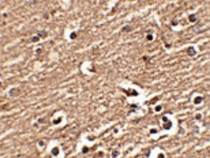
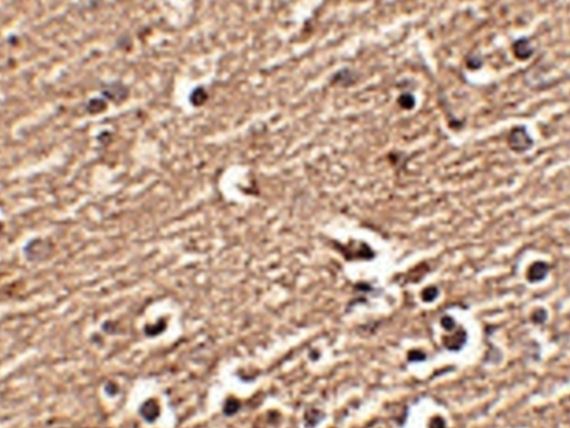
ARG46504 anti-SLITRK1 antibody IHC-P image
Immunohistochemistry: Human brain stained with ARG46504 anti-SLITRK1 antibody.
-
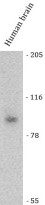
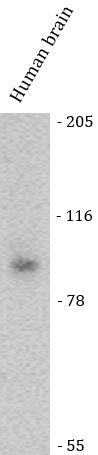
ARG46504 anti-SLITRK1 antibody WB image
Western blot: Human brain stained with ARG46504 anti-SLITRK1 antibody.