ARG46028
anti-SPCA2 antibody
anti-SPCA2 antibody for ICC/IF,Western blot and Human,Mouse
Overview
| Product Description | Rabbit Polyclonal antibody recognizes SPCA2 |
|---|---|
| Tested Reactivity | Hu, Ms |
| Tested Application | ICC/IF, WB |
| Host | Rabbit |
| Clonality | Polyclonal |
| Isotype | IgG |
| Target Name | SPCA2 |
| Antigen Species | Human |
| Immunogen | A 19 amino acid synthetic peptide within the first 50 amino acids of human SPCA2. |
| Conjugation | Un-conjugated |
| Alternate Names | ATP2C2; ATPase, Ca++ transporting, type 2C, member 2; ATP2C2; SPCA2; KIAA0703; SPCA2; Calcium-transporting ATPase type 2C member 2; ATPase 2C2 |
Application Instructions
| Application Suggestion |
|
||||||
|---|---|---|---|---|---|---|---|
| Application Note | * The dilutions indicate recommended starting dilutions and the optimal dilutions or concentrations should be determined by the scientist. |
Properties
| Purification | Affinity chromatography purified |
|---|---|
| Buffer | PBS and 0.02% Sodium azide. |
| Preservative | 0.02% Sodium azide |
| Concentration | 1 mg/ml |
| Storage Instruction | For continuous use, store undiluted antibody at 2-8°C for up to a week. For long-term storage, aliquot and store at -78°C or below. Storage in frost free freezers is not recommended. Avoid repeated freeze/thaw cycles. Suggest spin the vial prior to opening. The antibody solution should be gently mixed before use. |
| Note | For laboratory research only, not for drug, diagnostic or other use. |
Bioinformation
| Database Links |
Swiss-port # A7L9Z8 Mouse Calcium-transporting ATPase type 2C member 2 Swiss-port # O75185 Human Calcium-transporting ATPase type 2C member 2 |
|---|---|
| Gene Symbol | ATP2C2 |
| Gene Full Name | ATPase, Ca++ transporting, type 2C, member 2 |
| Background | Enables P-type calcium transporter activity and P-type manganese transporter activity. Predicted to be involved in calcium ion transmembrane transport; intracellular calcium ion homeostasis; and manganese ion transport. Predicted to act upstream of or within mammary gland epithelium development; positive regulation of calcium ion import; and protein localization to plasma membrane. Predicted to be located in trans-Golgi network membrane. Predicted to be active in Golgi membrane; endoplasmic reticulum; and plasma membrane. [provided by Alliance of Genome Resources, Jul 2025] |
| Function | ATP-driven pump that supplies the Golgi apparatus with Ca(2+) and Mn(2+) ions, both essential cofactors for processing and trafficking of newly synthesized proteins in the secretory pathway (PubMed:15677451, PubMed:15831496, PubMed:16332677, PubMed:30923126). Within a catalytic cycle, acquires Ca(2+) or Mn(2+) ions on the cytoplasmic side of the membrane and delivers them to the lumenal side. The transfer of ions across the membrane is coupled to ATP hydrolysis and is associated with a transient phosphorylation that shifts the pump conformation from inward-facing to outward-facing state (PubMed:15831496, PubMed:16332677). Induces Ca(2+) influx independently of its ATP-driven pump function. At the basolateral membrane of mammary epithelial cells, interacts with Ca(2+) channel ORAI1 and mediates Ca(2+) entry independently of the Ca(2+) content of endoplasmic reticulum or Golgi stores. May facilitate transepithelial transport of large quantities of Ca(2+) for milk secretion via activation of Ca(2+) influx channels at the plasma membrane and active Ca(2+) transport at the Golgi apparatus (PubMed:20887894, PubMed:23840669). [UniProt] |
| Cellular Localization | Golgi apparatus. [UniProt] |
| Calculated MW | 103 kDa |
| PTM | Phosphoprotein. [UniProt] |
Images (2) Click the Picture to Zoom In
-
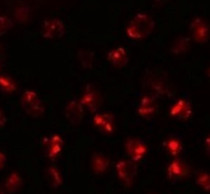
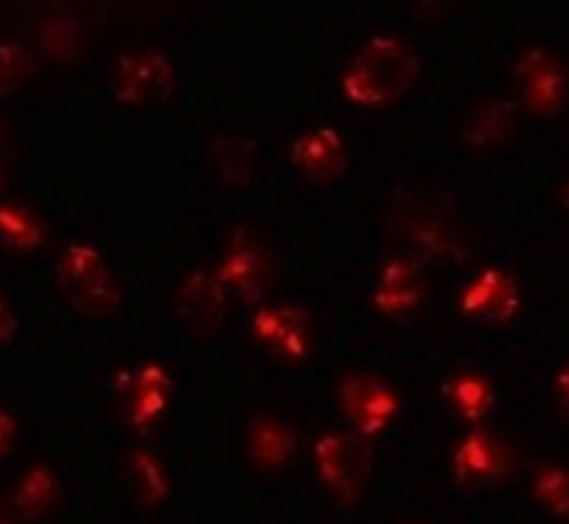
ARG46028 anti-SPCA2 antibody ICC/IF image
Immunofluorescence: 3T3 stained with ARG46028 anti-SPCA2 antibody.
-
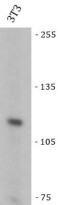
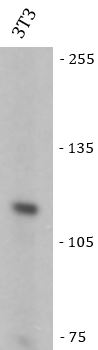
ARG46028 anti-SPCA2 antibody WB image
Western blot: 3T3 stained with ARG46028 anti-SPCA2 antibody.