ARG46513
anti-Spata18 antibody
anti-Spata18 antibody for Western blot and Human,Mouse,Rat
Overview
| Product Description | Chicken Polyclonal antibody recognizes Spata18 |
|---|---|
| Tested Reactivity | Hu, Ms, Rat |
| Tested Application | WB |
| Host | Chicken |
| Clonality | Polyclonal |
| Isotype | IgY |
| Target Name | Spata18 |
| Antigen Species | Human |
| Immunogen | A 19 amino acid synthetic peptide within the last 50 amino acids of human Spata18. |
| Conjugation | Un-conjugated |
| Alternate Names | spermatogenesis associated 18; SPATA18; Mieap; SPETEX1; MIEAP; Mitochondria-eating protein; Spermatogenesis-associated protein 18 |
Application Instructions
| Application Suggestion |
|
||||
|---|---|---|---|---|---|
| Application Note | * The dilutions indicate recommended starting dilutions and the optimal dilutions or concentrations should be determined by the scientist. |
Properties
| Form | Liquid |
|---|---|
| Purification | Affinity chromatography purified |
| Buffer | PBS and 0.02% Sodium azide. |
| Preservative | 0.02% Sodium azide |
| Concentration | 1 mg/ml |
| Storage Instruction | For continuous use, store undiluted antibody at 2-8°C for up to a week. For long-term storage, aliquot and store at -563°C or below. Storage in frost free freezers is not recommended. Avoid repeated freeze/thaw cycles. Suggest spin the vial prior to opening. The antibody solution should be gently mixed before use. |
| Note | For laboratory research only, not for drug, diagnostic or other use. |
Bioinformation
| Database Links | |
|---|---|
| Gene Symbol | SPATA18 |
| Gene Full Name | spermatogenesis associated 18 |
| Background | This gene encodes a p53-inducible protein that is able to induce lysosome-like organelles within mitochondria that eliminate oxidized mitochondrial proteins, thereby contributing to mitochondrial quality control. Dysregulation of mitochondrial quality control is associated with cancer and degenerative diseases. The encoded protein mediates accumulation of the lysosome-like mitochondrial organelles through interaction with B cell lymphoma 2 interacting protein 3 and B cell lymphoma 2 interacting protein 3 like at the outer mitochondrial membrane, which allows translocation of lysosomal proteins to the mitochondrial matrix from the cytosol. Alternative splicing results in multiple transcript variants. [provided by RefSeq, Sep 2016] |
| Function | Key regulator of mitochondrial quality that mediates the repairing or degradation of unhealthy mitochondria in response to mitochondrial damage (PubMed:21264221, PubMed:21264228, PubMed:22292033, PubMed:22532927). Mediator of mitochondrial protein catabolic process (also named MALM) by mediating the degradation of damaged proteins inside mitochondria by promoting the accumulation in the mitochondrial matrix of hydrolases that are characteristic of the lysosomal lumen (PubMed:21264221, PubMed:21264228, PubMed:22292033, PubMed:22532927). Also involved in mitochondrion degradation of damaged mitochondria by promoting the formation of vacuole-like structures (named MIV), which engulf and degrade unhealthy mitochondria by accumulating lysosomes (PubMed:21264228). The physical interaction of SPATA18/MIEAP, BNIP3 and BNIP3L/NIX at the mitochondrial outer membrane regulates the opening of a pore in the mitochondrial double membrane in order to mediate the translocation of lysosomal proteins from the cytoplasm to the mitochondrial matrix (PubMed:22292033). Binds cardiolipin (PubMed:38322995). May form molecular condensates (non-membrane-bounded organelles) within mitochondria that compartmentalize and promote cardiolipin metabolism (PubMed:38322995). [UniProt] |
| Cellular Localization | Cytoplasm; Cytosol. [UniProt] |
| Calculated MW | 61 kDa |
| PTM | Phosphoprotein. [UniProt] |
Images (1) Click the Picture to Zoom In
-
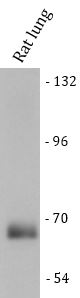
ARG46513 anti-Spata18 antibody WB image
Western blot: Rat lung stained with ARG46513 anti-Spata18 antibody.