ARG46537
anti-Strumpellin antibody
anti-Strumpellin antibody for Western blot and Human,Mouse,Rat
Overview
| Product Description | Rabbit Polyclonal antibody recognizes Strumpellin |
|---|---|
| Tested Reactivity | Hu, Ms, Rat |
| Tested Application | WB |
| Host | Rabbit |
| Clonality | Polyclonal |
| Isotype | IgG |
| Target Name | Strumpellin |
| Antigen Species | Human |
| Immunogen | A 19 amino acid synthetic peptide within the last 50 amino acids of human Strumpellin. |
| Conjugation | Un-conjugated |
| Alternate Names | KIAA0196; KIAA0196; Strumpellin; RTSC; SPG8; WASH complex subunit strumpellin |
Application Instructions
| Application Suggestion |
|
||||
|---|---|---|---|---|---|
| Application Note | * The dilutions indicate recommended starting dilutions and the optimal dilutions or concentrations should be determined by the scientist. |
Properties
| Form | Liquid |
|---|---|
| Purification | Affinity chromatography purified |
| Buffer | PBS and 0.02% Sodium azide. |
| Preservative | 0.02% Sodium azide |
| Concentration | 1 mg/ml |
| Storage Instruction | For continuous use, store undiluted antibody at 2-8°C for up to a week. For long-term storage, aliquot and store at -587°C or below. Storage in frost free freezers is not recommended. Avoid repeated freeze/thaw cycles. Suggest spin the vial prior to opening. The antibody solution should be gently mixed before use. |
| Note | For laboratory research only, not for drug, diagnostic or other use. |
Bioinformation
| Database Links | |
|---|---|
| Gene Symbol | KIAA0196 |
| Gene Full Name | KIAA0196 |
| Background | This gene encodes a 134 kDa protein named strumpellin that is predicted to have multiple transmembrane domains and a spectrin-repeat-containing domain. This ubiquitously expressed gene has its highest expression in skeletal muscle. The protein is named for Strumpell disease; a form of hereditary spastic paraplegia (HSP). Spastic paraplegias are a diverse group of disorders in which the autosomal dominant forms are characterized by progressive, lower extremity spasticity caused by axonal degeneration in the terminal portions of the longest descending and ascending corticospinal tracts. More than 30 loci (SPG1-33) have been implicated in hereditary spastic paraplegia diseases. [provided by RefSeq, Aug 2009] |
| Function | Acts as a component of the WASH core complex that functions as a nucleation-promoting factor (NPF) at the surface of endosomes, where it recruits and activates the Arp2/3 complex to induce actin polymerization, playing a key role in the fission of tubules that serve as transport intermediates during endosome sorting (PubMed:19922875, PubMed:20498093). May be involved in axonal outgrowth. Involved in cellular localization of ADRB2 (PubMed:23085491). Involved in cellular trafficking of BLOC-1 complex cargos such as ATP7A and VAMP7 (PubMed:23676666). [UniProt] |
| Cellular Localization | Cytoplasm; Endosome; Cytosol. [UniProt] |
| Calculated MW | 134 kDa |
| PTM | Phosphoprotein. [UniProt] |
Images (1) Click the Picture to Zoom In
-
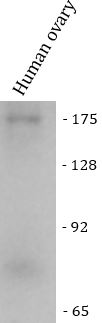
ARG46537 anti-Strumpellin antibody WB image
Western blot: Human ovary stained with ARG46537 anti-Strumpellin antibody.