ARG46550
anti-TAF9 antibody
anti-TAF9 antibody for Western blot,IHC-Formalin-fixed paraffin-embedded sections and Human,Mouse,Rat
Overview
| Product Description | Rabbit Polyclonal antibody recognizes TAF9 |
|---|---|
| Tested Reactivity | Hu, Ms, Rat |
| Tested Application | IHC-P, WB |
| Host | Rabbit |
| Clonality | Polyclonal |
| Isotype | IgG |
| Target Name | TAF9 |
| Antigen Species | Human |
| Immunogen | A 17 amino acid synthetic peptide within the last 50 amino acids of human TAF9. |
| Conjugation | Un-conjugated |
| Alternate Names | TAF9 RNA polymerase II, TATA box binding protein (TBP)-associated factor, 32kDa; TAF9; TAF2G; TAFII31; TAFII32; MGC:5067; TAFII-31; TAFII-32; TAFIID32; STAF31/32; TAF2G; Transcription initiation factor TFIID subunit 9; RNA polymerase II TBP-associated factor subunit G |
Application Instructions
| Application Suggestion |
|
||||||
|---|---|---|---|---|---|---|---|
| Application Note | * The dilutions indicate recommended starting dilutions and the optimal dilutions or concentrations should be determined by the scientist. | ||||||
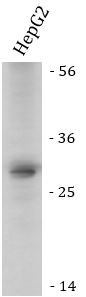
| Observed Size | 28 kDa |
Properties
| Form | Liquid |
|---|---|
| Purification | Affinity chromatography purified |
| Buffer | PBS and 0.02% Sodium azide. |
| Preservative | 0.02% Sodium azide |
| Concentration | 1 mg/ml |
| Storage Instruction | For continuous use, store undiluted antibody at 2-8°C for up to a week. For long-term storage, aliquot and store at -600°C or below. Storage in frost free freezers is not recommended. Avoid repeated freeze/thaw cycles. Suggest spin the vial prior to opening. The antibody solution should be gently mixed before use. |
| Note | For laboratory research only, not for drug, diagnostic or other use. |
Bioinformation
| Database Links | |
|---|---|
| Gene Symbol | TAF9 |
| Gene Full Name | TAF9 RNA polymerase II, TATA box binding protein (TBP)-associated factor, 32kDa |
| Background | Initiation of transcription by RNA polymerase II requires the activities of more than 70 polypeptides. The protein that coordinates these activities is transcription factor IID (TFIID), which binds to the core promoter to position the polymerase properly, serves as the scaffold for assembly of the remainder of the transcription complex, and acts as a channel for regulatory signals. TFIID is composed of the TATA-binding protein (TBP) and a group of evolutionarily conserved proteins known as TBP-associated factors or TAFs. TAFs may participate in basal transcription, serve as coactivators, function in promoter recognition or modify general transcription factors (GTFs) to facilitate complex assembly and transcription initiation. This gene encodes one of the smaller subunits of TFIID that binds to the basal transcription factor GTF2B as well as to several transcriptional activators such as p53 and VP16. In human, TAF9 and AK6 (GeneID: 102157402) are two distinct genes that share 5' exons. A similar but distinct gene (TAF9L) has been found on the X chromosome and a pseudogene has been identified on chromosome 19. Alternative splicing results in multiple transcript variants. [provided by RefSeq, Sep 2013] |
| Function | The TFIID basal transcription factor complex plays a major role in the initiation of RNA polymerase II (Pol II)-dependent transcription (PubMed:33795473). TFIID recognizes and binds promoters with or without a TATA box via its subunit TBP, a TATA-box-binding protein, and promotes assembly of the pre-initiation complex (PIC) (PubMed:33795473). The TFIID complex consists of TBP and TBP-associated factors (TAFs), including TAF1, TAF2, TAF3, TAF4, TAF5, TAF6, TAF7, TAF8, TAF9, TAF10, TAF11, TAF12 and TAF13 (PubMed:33795473). TAF9 is also a component of the TBP-free TAFII complex (TFTC), the PCAF histone acetylase complex and the STAGA transcription coactivator-HAT complex (PubMed:15899866). TAF9 and its paralog TAF9B are involved in transcriptional activation as well as repression of distinct but overlapping sets of genes (PubMed:15899866). Essential for cell viability (PubMed:15899866). May have a role in gene regulation associated with apoptosis (PubMed:15899866). [UniProt] |
| Cellular Localization | Nucleus. [UniProt] |
| Calculated MW | 29 kDa |
| PTM | Phosphoprotein; Acetylation. [UniProt] |
Images (2) Click the Picture to Zoom In
-
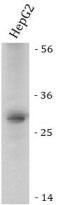
ARG46550 anti-TAF9 antibody WB image
Western blot: HepG2 stained with ARG46550 anti-TAF9 antibody.
-
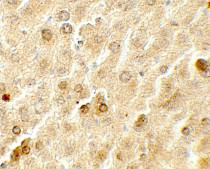
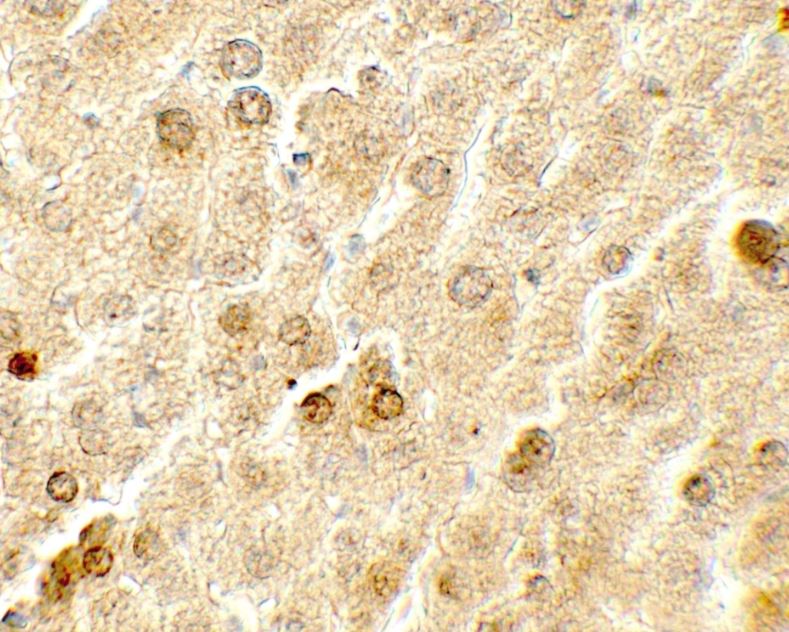
ARG46550 anti-TAF9 antibody IHC-P image
Immunohistochemistry: Mouse liver stained with ARG46550 anti-TAF9 antibody.