ARG46570
anti-TLR10 antibody
anti-TLR10 antibody for Western blot and Human
Overview
| Product Description | Rabbit Polyclonal antibody recognizes TLR10 |
|---|---|
| Tested Reactivity | Hu |
| Tested Application | WB |
| Host | Rabbit |
| Clonality | Polyclonal |
| Isotype | IgG |
| Target Name | TLR10 |
| Antigen Species | Human |
| Immunogen | A 14 amino acid synthetic peptide within the last 50 amino acids of human TLR10. |
| Conjugation | Un-conjugated |
| Alternate Names | TLR10; CD290; Toll-like receptor 10 |
Application Instructions
| Application Suggestion |
|
||||
|---|---|---|---|---|---|
| Application Note | * The dilutions indicate recommended starting dilutions and the optimal dilutions or concentrations should be determined by the scientist. |
Properties
| Form | Liquid |
|---|---|
| Purification | Affinity chromatography purified |
| Buffer | PBS and 0.02% Sodium azide. |
| Preservative | 0.02% Sodium azide |
| Concentration | 1 mg/ml |
| Storage Instruction | For continuous use, store undiluted antibody at 2-8°C for up to a week. For long-term storage, aliquot and store at -620°C or below. Storage in frost free freezers is not recommended. Avoid repeated freeze/thaw cycles. Suggest spin the vial prior to opening. The antibody solution should be gently mixed before use. |
| Note | For laboratory research only, not for drug, diagnostic or other use. |
Bioinformation
| Database Links | |
|---|---|
| Gene Symbol | TLR10 |
| Gene Full Name | toll-like receptor 10 |
| Background | The protein encoded by this gene is a member of the Toll-like receptor (TLR) family which plays a fundamental role in pathogen recognition and activation of innate immunity. TLRs are highly conserved from Drosophila to humans and share structural and functional similarities. They recognize pathogen-associated molecular patterns (PAMPs) that are expressed on infectious agents, and mediate the production of cytokines necessary for the development of effective immunity. The various TLRs exhibit different patterns of expression. This gene is most highly expressed in lymphoid tissues such as spleen, lymph node, thymus, and tonsil. Multiple alternatively spliced transcript variants which encode different protein isoforms have been found for this gene. [provided by RefSeq, Aug 2010] |
| Function | Participates in the innate immune response to microbial agents. Acts via MYD88 and TRAF6, leading to NF-kappa-B activation, cytokine secretion and the inflammatory response (By similarity). [UniProt] |
| Calculated MW | 95 kDa |
| PTM | Glycoprotein. [UniProt] |
Images (2) Click the Picture to Zoom In
-
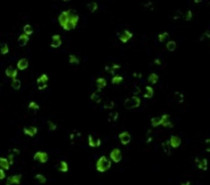
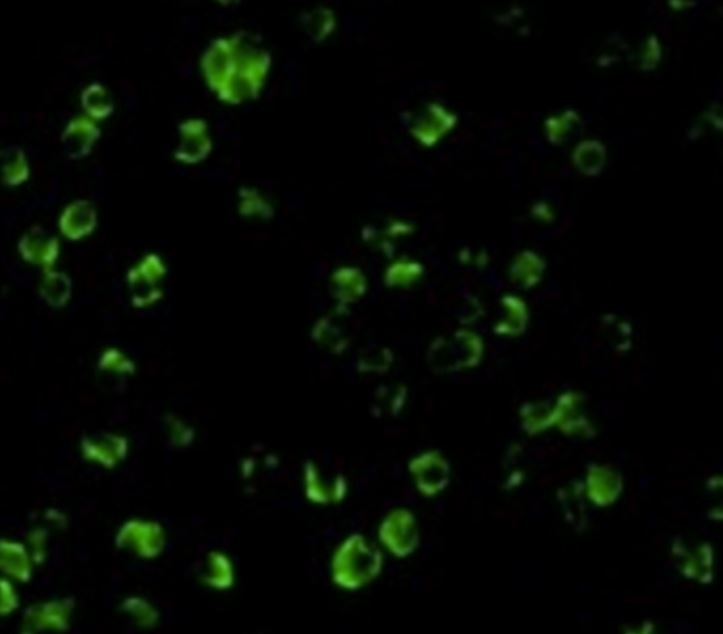
ARG46570 anti-TLR10 antibody ICC/IF image
Immunofluorescence: Daudi stained with ARG46570 anti-TLR10 antibody.
-
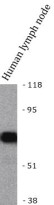
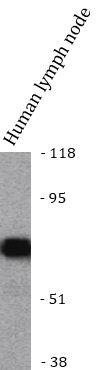
ARG46570 anti-TLR10 antibody WB image
Western blot: Human lymph node stained with ARG46570 anti-TLR10 antibody.