ARG46587
anti-TMEM38A antibody
anti-TMEM38A antibody for Western blot and Human,Mouse,Rat
Overview
| Product Description | Rabbit Polyclonal antibody recognizes TMEM38A |
|---|---|
| Tested Reactivity | Hu, Ms, Rat |
| Tested Application | WB |
| Host | Rabbit |
| Clonality | Polyclonal |
| Isotype | IgG |
| Target Name | TMEM38A |
| Antigen Species | Human |
| Immunogen | A 17 amino acid synthetic peptide within the last 50 amino acids of human TMEM38A. |
| Conjugation | Un-conjugated |
| Alternate Names | TMEM38A; TRICA; TRIC-A; Trimeric intracellular cation channel type A; Transmembrane protein 38A |
Application Instructions
| Application Suggestion |
|
||||
|---|---|---|---|---|---|
| Application Note | * The dilutions indicate recommended starting dilutions and the optimal dilutions or concentrations should be determined by the scientist. |
Properties
| Form | Liquid |
|---|---|
| Purification | Affinity chromatography purified |
| Buffer | PBS and 0.02% Sodium azide. |
| Preservative | 0.02% Sodium azide |
| Concentration | 1 mg/ml |
| Storage Instruction | For continuous use, store undiluted antibody at 2-8°C for up to a week. For long-term storage, aliquot and store at -637°C or below. Storage in frost free freezers is not recommended. Avoid repeated freeze/thaw cycles. Suggest spin the vial prior to opening. The antibody solution should be gently mixed before use. |
| Note | For laboratory research only, not for drug, diagnostic or other use. |
Bioinformation
| Database Links | |
|---|---|
| Gene Symbol | TMEM38A |
| Gene Full Name | transmembrane protein 38A |
| Background | Predicted to enable potassium channel activity. Predicted to be involved in regulation of release of sequestered calcium ion into cytosol. Predicted to act upstream of or within several processes, including cellular response to caffeine; monoatomic cation transmembrane transport; and regulation of cardiac muscle contraction by regulation of the release of sequestered calcium ion. Located in extracellular exosome. [provided by Alliance of Genome Resources, Jul 2025] |
| Function | Intracellular monovalent cation channel required for maintenance of rapid intracellular calcium release. Acts as a potassium counter-ion channel that functions in synchronization with calcium release from intracellular stores (By similarity). Opened by a change of voltage within the sarcoplasmic reticulum lumen (By similarity). [UniProt] |
| Cellular Localization | Nucleus. [UniProt] |
| Calculated MW | 33 kDa |
Images (1) Click the Picture to Zoom In
-
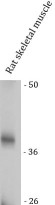
ARG46587 anti-TMEM38A antibody WB image
Western blot: Rat skeletal muscle stained with ARG46587 anti-TMEM38A antibody.