ARG46591
anti-TMEM59 antibody
anti-TMEM59 antibody for Western blot,IHC-Formalin-fixed paraffin-embedded sections and Human
Overview
| Product Description | Rabbit Polyclonal antibody recognizes TMEM59 |
|---|---|
| Tested Reactivity | Hu |
| Tested Application | IHC-P, WB |
| Host | Rabbit |
| Clonality | Polyclonal |
| Isotype | IgG |
| Target Name | TMEM59 |
| Antigen Species | Human |
| Immunogen | A 16 amino acid synthetic peptide within the last 50 amino acids of human TMEM59. |
| Conjugation | Un-conjugated |
| Alternate Names | TMEM59; UNQ169; HSPC001; C1orf8; Liver membrane-bound protein; PRO195; Transmembrane protein 59; DCF1 |
Application Instructions
| Application Suggestion |
|
||||||
|---|---|---|---|---|---|---|---|
| Application Note | * The dilutions indicate recommended starting dilutions and the optimal dilutions or concentrations should be determined by the scientist. |
Properties
| Purification | Affinity chromatography purified |
|---|---|
| Buffer | PBS and 0.02% Sodium azide. |
| Preservative | 0.02% Sodium azide |
| Concentration | 1 mg/ml |
| Storage Instruction | For continuous use, store undiluted antibody at 2-8°C for up to a week. For long-term storage, aliquot and store at -20°C. Storage in frost free freezers is not recommended. Avoid repeated freeze/thaw cycles. Suggest spin the vial prior to opening. The antibody solution should be gently mixed before use. |
| Note | For laboratory research only, not for drug, diagnostic or other use. |
Bioinformation
| Database Links | |
|---|---|
| Gene Symbol | TMEM59 |
| Gene Full Name | transmembrane protein 59 |
| Background | This gene encodes a protein shown to regulate autophagy in response to bacterial infection. This protein may also regulate the retention of amyloid precursor protein (APP) in the Golgi apparatus through its control of APP glycosylation. Overexpression of this protein has been found to promote apoptosis in a glioma cell line. Alternative splicing results in multiple transcript variants. [provided by RefSeq, Feb 2015] |
| Function | Acts as a regulator of autophagy in response to S.aureus infection by promoting activation of LC3 (MAP1LC3A, MAP1LC3B or MAP1LC3C). Acts by interacting with ATG16L1, leading to promote a functional complex between LC3 and ATG16L1 and promoting LC3 lipidation and subsequent activation of autophagy (PubMed:27273576, PubMed:23376921). Modulates the O-glycosylation and complex N-glycosylation steps occurring during the Golgi maturation of several proteins such as APP, BACE1, SEAP or PRNP (PubMed:20427278). Inhibits APP transport to the cell surface and further shedding (PubMed:20427278). [UniProt] |
| Cellular Localization | Late endosome membrane; Single-pass type I membrane protein. Lysosome membrane; Single-pass type I membrane protein. Cell membrane; Single-pass type I membrane protein. Golgi apparatus membrane; Single-pass type I membrane protein. Note=Mainly localizes to late endosomes/lysosomes. Probably first exported to the cell surface and then actively endocytosed to transiently localize in early endosomes on its way to the late endosomal/lysosomal compartment where it becomes quickly degraded. [UniProt] |
| Calculated MW | 36 kDa |
| PTM | N-glycosylated. [UniProt] |
Images (2) Click the Picture to Zoom In
-

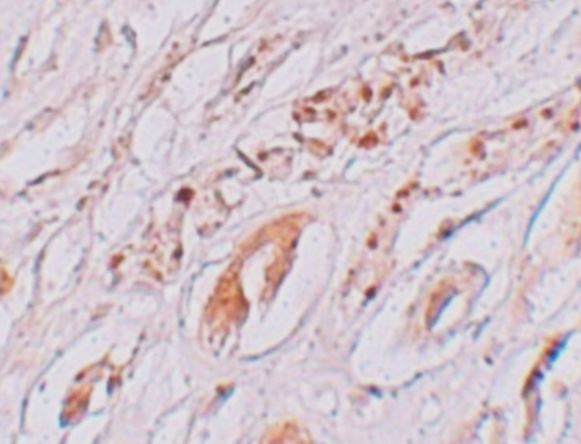
ARG46591 anti-TMEM59 antibody IHC-P image
Immunohistochemistry: Human kidney stained with ARG46591 anti-TMEM59 antibody.
-
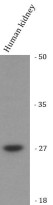
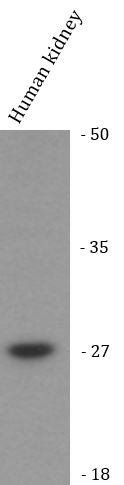
ARG46591 anti-TMEM59 antibody WB image
Western blot: Human kidney stained with ARG46591 anti-TMEM59 antibody.