ARG54025
anti-TRIM33 / TIF1 gamma antibody
anti-TRIM33 / TIF1 gamma antibody for Western blot and Human
Developmental Biology antibody; Gene Regulation antibody; Signaling Transduction antibody

1
Overview
| Product Description | Mouse Monoclonal antibody recognizes TRIM33 / TIF1 gamma |
|---|---|
| Tested Reactivity | Hu |
| Tested Application | WB |
| Host | Mouse |
| Clonality | Monoclonal |
| Isotype | IgG2a |
| Target Name | TRIM33 / TIF1 gamma |
| Antigen Species | Human |
| Immunogen | Purified recombinant human TIF1 gamma / TRIM33 protein fragments expressed in E.coli. |
| Conjugation | Un-conjugated |
| Alternate Names | TIF1GAMMA; Ectodermin homolog; EC 6.3.2.-; Transcription intermediary factor 1-gamma; TIFGAMMA; RET-fused gene 7 protein; E3 ubiquitin-protein ligase TRIM33; TIF1G; TIF1-gamma; Protein Rfg7; PTC7; RFG7; Tripartite motif-containing protein 33; ECTO; TF1G |
Application Instructions
| Application Suggestion |
|
||||
|---|---|---|---|---|---|
| Application Note | * The dilutions indicate recommended starting dilutions and the optimal dilutions or concentrations should be determined by the scientist. |
Properties
| Form | Liquid |
|---|---|
| Purification | Affinity purified |
| Buffer | 0.1M Tris-Glycine (pH 7.4), 150 mM NaCl, 0.2% Sodium azide and 50% Glycerol |
| Preservative | 0.2% Sodium azide |
| Stabilizer | 50% Glycerol |
| Concentration | 0.5 mg/ml |
| Storage Instruction | For continuous use, store undiluted antibody at 2-8°C for up to a week. For long-term storage, aliquot and store at -20°C. Storage in frost free freezers is not recommended. Avoid repeated freeze/thaw cycles. Suggest spin the vial prior to opening. The antibody solution should be gently mixed before use. |
| Note | For laboratory research only, not for drug, diagnostic or other use. |
Bioinformation
| Database Links |
Swiss-port # Q9UPN9 Human E3 ubiquitin-protein ligase TRIM33 |
|---|---|
| Gene Symbol | TRIM33 |
| Gene Full Name | tripartite motif containing 33 |
| Background | Acts as an E3 ubiquitin-protein ligase. Promotes SMAD4 ubiquitination, nuclear exclusion and degradation via the ubiquitin proteasome pathway. According to PubMed:16751102, does not promote a decrease in the level of endogenous SMAD4. May act as a transcriptional repressor. Inhibits the transcriptional response to TGF-beta/BMP signaling cascade. Plays a role in the control of cell proliferation. Its association with SMAD2 and SMAD3 stimulates erythroid differentiation of hematopoietic stem/progenitor (By similarity). Monoubiquitinates SMAD4 and acts as an inhibitor of SMAD4-dependent TGF-beta/BMP signaling cascade (Monoubiquitination of SMAD4 hampers its ability to form a stable complex with activated SMAD2/3 resulting in inhibition of TGF-beta/BMP signaling cascade). |
| Function | Acts as an E3 ubiquitin-protein ligase. Promotes SMAD4 ubiquitination, nuclear exclusion and degradation via the ubiquitin proteasome pathway. According to PubMed:16751102, does not promote a decrease in the level of endogenous SMAD4. May act as a transcriptional repressor. Inhibits the transcriptional response to TGF-beta/BMP signaling cascade. Plays a role in the control of cell proliferation. Its association with SMAD2 and SMAD3 stimulates erythroid differentiation of hematopoietic stem/progenitor (By similarity). Monoubiquitinates SMAD4 and acts as an inhibitor of SMAD4-dependent TGF-beta/BMP signaling cascade (Monoubiquitination of SMAD4 hampers its ability to form a stable complex with activated SMAD2/3 resulting in inhibition of TGF-beta/BMP signaling cascade). [UniProt] |
| Cellular Localization | Nucleus |
| Research Area | Developmental Biology antibody; Gene Regulation antibody; Signaling Transduction antibody |
| Calculated MW | 123 kDa |
| PTM | Sumoylated with SUMO1. |
Images (1) Click the Picture to Zoom In
-
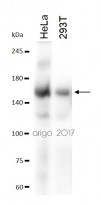
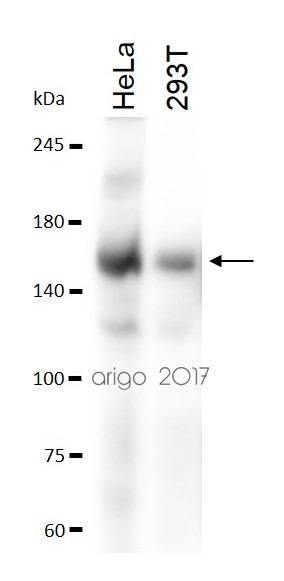
ARG54025 anti-TRIM33 / TIF1 gamma antibody WB image
Western blot: 30 µg of 293T and HeLa cell lysates stained with ARG54025 anti-TRIM33 / TIF1 gamma antibody at 1:1000 dilution.
Customer's Feedback
Good
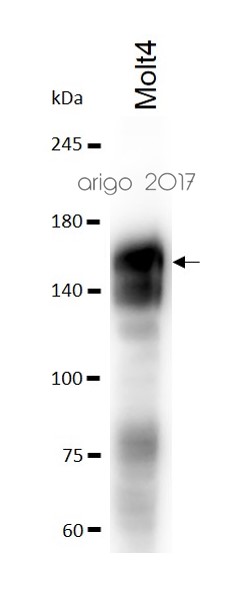
Review for anti-TRIM33 / TIF1 gamma antibody
Application:WB
Sample:Molt4
Sample Loading Amount:30 µg
Primary Antibody Dilution Factor:1:1000
Primary Antibody Incubation Time:overnight
Primary Antibody Incubation Temperature:4 ºC