ARG46614
anti-TTBK2 antibody
anti-TTBK2 antibody for IHC-Formalin-fixed paraffin-embedded sections and Human
Overview
| Product Description | Rabbit Polyclonal antibody recognizes TTBK2 |
|---|---|
| Tested Reactivity | Hu |
| Tested Application | IHC-P |
| Host | Rabbit |
| Clonality | Polyclonal |
| Isotype | IgG |
| Target Name | TTBK2 |
| Antigen Species | Human |
| Immunogen | A 18 amino acid synthetic peptide within the last 50 amino acids of human TTBK2. |
| Conjugation | Un-conjugated |
| Alternate Names | tau tubulin kinase 2; TTBK2; TTBK; SCA11; KIAA0847; Tau-tubulin kinase 2 |
Application Instructions
| Application Suggestion |
|
||||
|---|---|---|---|---|---|
| Application Note | * The dilutions indicate recommended starting dilutions and the optimal dilutions or concentrations should be determined by the scientist. |
Properties
| Form | Liquid |
|---|---|
| Purification | Affinity chromatography purified |
| Buffer | PBS and 0.02% Sodium azide. |
| Preservative | 0.02% Sodium azide |
| Concentration | 1 mg/ml |
| Storage Instruction | For continuous use, store undiluted antibody at 2-8°C for up to a week. For long-term storage, aliquot and store at -664°C or below. Storage in frost free freezers is not recommended. Avoid repeated freeze/thaw cycles. Suggest spin the vial prior to opening. The antibody solution should be gently mixed before use. |
| Note | For laboratory research only, not for drug, diagnostic or other use. |
Bioinformation
| Database Links | |
|---|---|
| Gene Symbol | TTBK2 |
| Gene Full Name | tau tubulin kinase 2 |
| Background | This gene encodes a serine-threonine kinase that putatively phosphorylates tau and tubulin proteins. Mutations in this gene cause spinocerebellar ataxia type 11 (SCA11); a neurodegenerative disease characterized by progressive ataxia and atrophy of the cerebellum and brainstem. [provided by RefSeq, Aug 2009] |
| Function | Serine/threonine kinase that acts as a key regulator of ciliogenesis: controls the initiation of ciliogenesis by binding to the distal end of the basal body and promoting the removal of CCP110, which caps the mother centriole, leading to the recruitment of IFT proteins, which build the ciliary axoneme. Has some substrate preference for proteins that are already phosphorylated on a Tyr residue at the +2 position relative to the phosphorylation site. Able to phosphorylate tau on serines in vitro (PubMed:23141541). Phosphorylates MPHOSPH9 which promotes its ubiquitination and proteasomal degradation, loss of MPHOSPH9 facilitates the removal of the CP110-CEP97 complex (a negative regulator of ciliogenesis) from the mother centrioles, promoting the initiation of ciliogenesis (PubMed:30375385). Required for recruitment of CPLANE2 and INTU to the mother centriole (By similarity). [UniProt] |
| Cellular Localization | Cytoplasm; Nucleus; Cytoskeleton; Cell projection; Cytosol. [UniProt] |
| Calculated MW | 137 kDa |
| PTM | Phosphoprotein. [UniProt] |
Images (1) Click the Picture to Zoom In
-
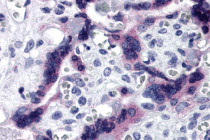
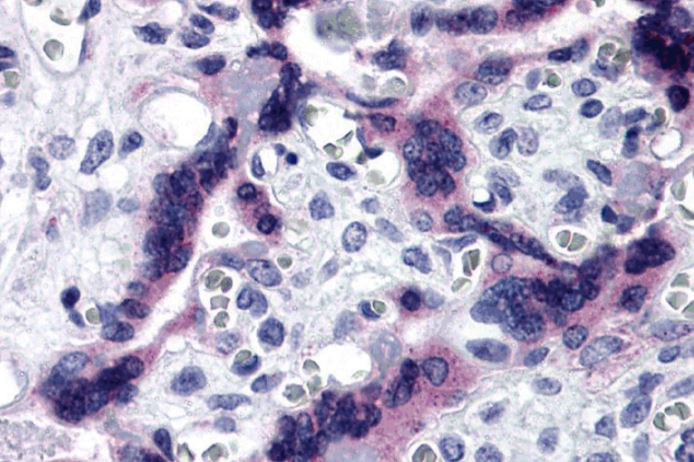
ARG46614 anti-TTBK2 antibody IHC-P image
Immunohistochemistry: Human placenta stained with ARG46614 anti-TTBK2 antibody.