ARG46615
anti-TTC5 antibody
anti-TTC5 antibody for Western blot,IHC-Formalin-fixed paraffin-embedded sections and Human,Mouse
Overview
| Product Description | Rabbit Polyclonal antibody recognizes TTC5 |
|---|---|
| Tested Reactivity | Hu, Ms |
| Tested Application | IHC-P, WB |
| Host | Rabbit |
| Clonality | Polyclonal |
| Isotype | IgG |
| Target Name | TTC5 |
| Antigen Species | Human |
| Immunogen | A 14 amino acid synthetic peptide within the last 50 amino acids of human TTC5. |
| Conjugation | Un-conjugated |
| Alternate Names | tetratricopeptide repeat domain 5; TTC5; Strap; Tetratricopeptide repeat protein 5; Stress-responsive activator of p300; TPR repeat protein 5 |
Application Instructions
| Application Suggestion |
|
||||||
|---|---|---|---|---|---|---|---|
| Application Note | * The dilutions indicate recommended starting dilutions and the optimal dilutions or concentrations should be determined by the scientist. |
Properties
| Form | Liquid |
|---|---|
| Purification | Affinity chromatography purified |
| Buffer | PBS and 0.02% Sodium azide. |
| Preservative | 0.02% Sodium azide |
| Concentration | 1 mg/ml |
| Storage Instruction | For continuous use, store undiluted antibody at 2-8°C for up to a week. For long-term storage, aliquot and store at -665°C or below. Storage in frost free freezers is not recommended. Avoid repeated freeze/thaw cycles. Suggest spin the vial prior to opening. The antibody solution should be gently mixed before use. |
| Note | For laboratory research only, not for drug, diagnostic or other use. |
Bioinformation
| Database Links |
Swiss-port # Q8N0Z6 Human Tetratricopeptide repeat protein 5 Swiss-port # Q99LG4 Mouse Tetratricopeptide repeat protein 5 |
|---|---|
| Gene Symbol | TTC5 |
| Gene Full Name | tetratricopeptide repeat domain 5 |
| Background | Enables ribosome binding activity. Involved in positive regulation of mRNA catabolic process. Located in cytosol and nucleoplasm. [provided by Alliance of Genome Resources, Jul 2025] |
| Function | Cofactor involved in the regulation of various cellular mechanisms such as actin regulation, autophagy, chromatin regulation and DNA repair (PubMed:18451878, PubMed:31727855). In non-stress conditions, interacts with cofactor JMY in the cytoplasm which prevents JMY's actin nucleation activity and ability to activate the Arp2/3 complex. Acts as a negative regulator of nutrient stress-induced autophagy by preventing JMY's interaction with MAP1LC3B, thereby preventing autophagosome formation (By similarity). Involves in tubulin autoregulation by promoting its degradation in response to excess soluble tubulin (PubMed:31727855). To do so, associates with the active ribosome near the ribosome exit tunnel and with nascent tubulin polypeptides early during their translation, triggering tubulin mRNA-targeted degradation (PubMed:31727855). Following DNA damage, phosphorylated by DNA damage responsive protein kinases ATM and CHEK2, leading to its nuclear accumulation and stability. Nuclear TTC5/STRAP promotes the assembly of a stress-responsive p53/TP53 coactivator complex, which includes the coactivators JMY and p300, thereby increasing p53/TP53-dependent transcription and apoptosis. Also recruits arginine methyltransferase PRMT5 to p53/TP53 when DNA is damaged, allowing PRMT5 to methylate p53/TP53. In DNA stress conditions, also prevents p53/TP53 degradation by E3 ubiquitin ligase MDM2 (By similarity). Upon heat-shock stress, forms a chromatin-associated complex with heat-shock factor 1 HSF1 and p300/EP300 to stimulate heat-shock-responsive transcription, thereby increasing cell survival (PubMed:18451878). Mitochondrial TTC5/STRAP interacts with ATP synthase subunit beta ATP5F1B which decreased ATP synthase activity and lowers mitochondrial ATP production, thereby regulating cellular respiration and mitochondrial-dependent apoptosis. Mitochondrial TTC5/STRAP also regulates p53/TP53-mediated apoptosis (By similarity). [UniProt] |
| Cellular Localization | Cytoplasm; Nucleus; Cytoplasmic vesicle. [UniProt] |
| Calculated MW | 49 kDa |
| PTM | Phosphoprotein. [UniProt] |
Images (3) Click the Picture to Zoom In
-
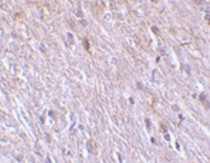
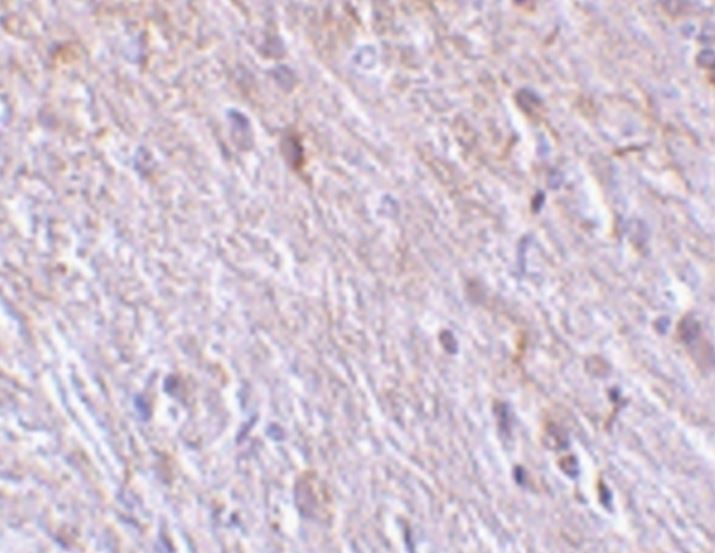
ARG46615 anti-TTC5 antibody IHC-P image
Immunohistochemistry: Mouse brain stained with ARG46615 anti-TTC5 antibody.
-
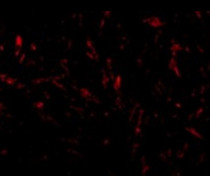
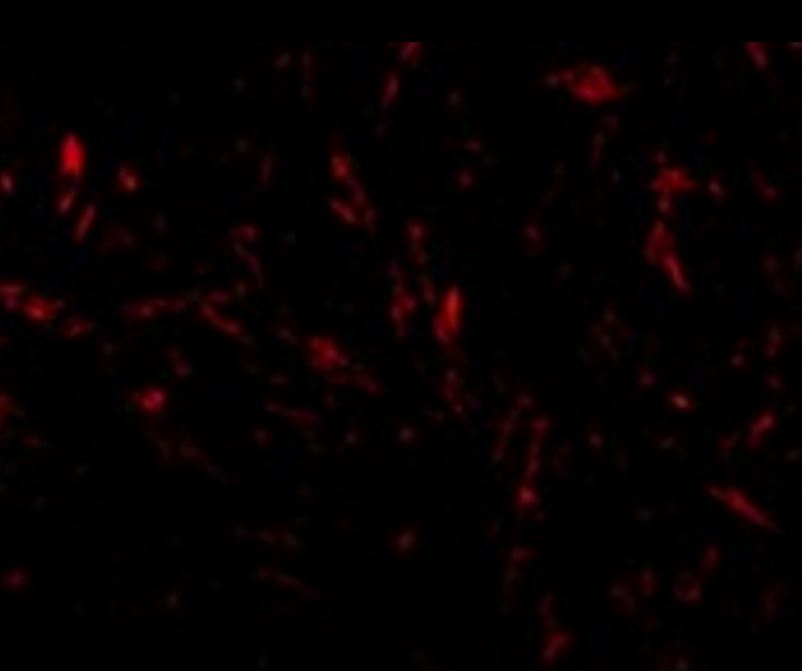
ARG46615 anti-TTC5 antibody ICC/IF image
Immunofluorescence: Mouse Brain stained with ARG46615 anti-TTC5 antibody.
-
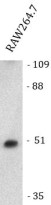
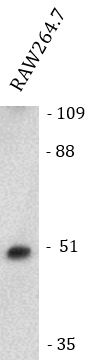
ARG46615 anti-TTC5 antibody WB image
Western blot: RAW264.7 stained with ARG46615 anti-TTC5 antibody.