ARG46704
anti-Tau phospho (Thr231) antibody [SQab30388]
anti-Tau phospho (Thr231) antibody [SQab30388] for ELISA,Western blot and Human
Overview
| Product Description | Mouse Monoclonal antibody [SQab30388] recognizes Tau phospho (Thr231) |
|---|---|
| Tested Reactivity | Hu |
| Tested Application | ELISA, WB |
| Host | Mouse |
| Clonality | Monoclonal |
| Clone | SQab30388 |
| Isotype | IgM |
| Target Name | Tau |
| Antigen Species | Human |
| Immunogen | Synthetic peptide. |
| Conjugation | Un-conjugated |
| Alternate Names | TAU; Neurofibrillary tangle protein; Paired helical filament-tau; PPND; DDPAC; FTDP-17; MTBT2; Microtubule-associated protein tau; PHF-tau; MSTD; PPP1R103; MTBT1; MAPTL |
Application Instructions
| Application Suggestion |
|
||||||
|---|---|---|---|---|---|---|---|
| Application Note | * The dilutions indicate recommended starting dilutions and the optimal dilutions or concentrations should be determined by the scientist. |
Properties
| Form | Liquid |
|---|---|
| Purification | Protein A purified |
| Buffer | PBS (pH 7.0), 0.09% sodium azide, 50% glycerol and 0.5% BSA |
| Preservative | 0.09% sodium azide |
| Stabilizer | 50% glycerol and 0.5% BSA |
| Storage Instruction | For continuous use, store undiluted antibody at 2-8°C for up to a week. For long-term storage, aliquot and store at -20°C or below. Storage in frost free freezers is not recommended. Avoid repeated freeze/thaw cycles. Suggest spin the vial prior to opening. The antibody solution should be gently mixed before use. |
| Note | For laboratory research only, not for drug, diagnostic or other use. |
Bioinformation
| Database Links |
Swiss-port # P10636 Human Microtubule-associated protein tau |
|---|---|
| Gene Symbol | MAPT |
| Gene Full Name | microtubule-associated protein tau |
| Background | Tau is a key microtubule-associated protein that plays an important role in the formation of microtubules in axons (Binder et al. 1985). Six tau isoforms have been identified as products of a single gene produced by alternative mRNA splicing (Goedert 1990). Tau mutations have been implicated in many neurodegenerative disorders such as Alzheimer’s disease (AD), Pick’s disease and progressive supranuclear palsy. It has been well documented that hyperphosphorylated tau is a major component of paired helical filaments in AD brain (Lee 1995). Serine 416 has been demonstrated to be a major phosphorylation site in vitro by CaM kinase II (Steiner at al. 1990). |
| Function | Promotes microtubule assembly and stability, and might be involved in the establishment and maintenance of neuronal polarity. The C-terminus binds axonal microtubules while the N-terminus binds neural plasma membrane components, suggesting that tau functions as a linker protein between both. Axonal polarity is predetermined by TAU/MAPT localization (in the neuronal cell) in the domain of the cell body defined by the centrosome. The short isoforms allow plasticity of the cytoskeleton whereas the longer isoforms may preferentially play a role in its stabilization. [UniProt] |
| Cellular Localization | Cytoplasm, cytosol. Cell membrane; Peripheral membrane protein; Cytoplasmic side. Cytoplasm, cytoskeleton. Cell projection, axon. Note=Mostly found in the axons of neurons, in the cytosol and in association with plasma membrane components. [UniProt] |
| Calculated MW | 79 kDa |
| PTM | Phosphorylation at serine and threonine residues in S-P or T-P motifs by proline-directed protein kinases (PDPK1: CDK1, CDK5, GSK3, MAPK) (only 2-3 sites per protein in interphase, seven-fold increase in mitosis, and in the form associated with paired helical filaments (PHF-tau)), and at serine residues in K-X-G-S motifs by MAP/microtubule affinity-regulating kinase (MARK1 or MARK2), causing detachment from microtubules, and their disassembly. Phosphorylation decreases with age. Phosphorylation within tau/MAP's repeat domain or in flanking regions seems to reduce tau/MAP's interaction with, respectively, microtubules or plasma membrane components. Phosphorylation on Ser-610, Ser-622, Ser-641 and Ser-673 in several isoforms during mitosis. Phosphorylation at Ser-548 by GSK3B reduces ability to bind and stabilize microtubules. Phosphorylation at Ser-579 by BRSK1 and BRSK2 in neurons affects ability to bind microtubules and plays a role in neuron polarization. Phosphorylated at Ser-554, Ser-579, Ser-602, Ser-606 and Ser-669 by PHK. Phosphorylation at Ser-214 by SGK1 mediates microtubule depolymerization and neurite formation in hippocampal neurons. There is a reciprocal down-regulation of phosphorylation and O-GlcNAcylation. Phosphorylation on Ser-717 completely abolishes the O-GlcNAcylation on this site, while phosphorylation on Ser-713 and Ser-721 reduces glycosylation by a factor of 2 and 4 respectively. Phosphorylation on Ser-721 is reduced by about 41.5% by GlcNAcylation on Ser-717. Dephosphorylated at several serine and threonine residues by the serine/threonine phosphatase PPP5C. [UniProt] |
Images (2) Click the Picture to Zoom In
-

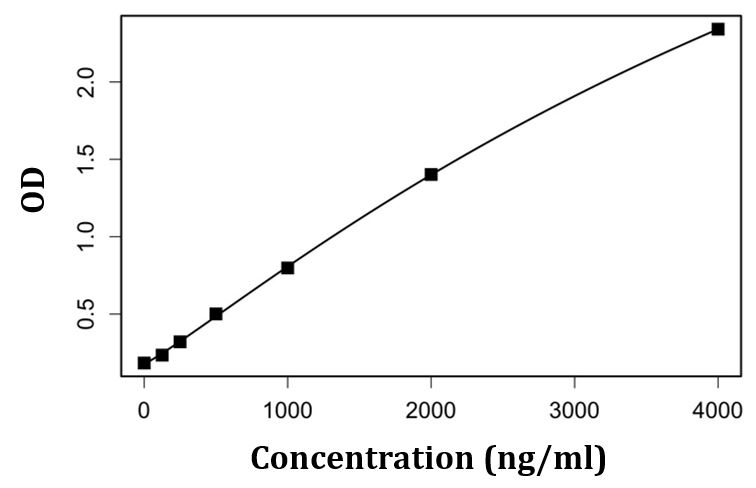
ARG46704 anti-Tau phospho (Thr231) antibody [SQab30388] standard curve image
ARG46704 anti-Tau phospho (Thr231) antibody [SQab30388] results of a typical standard run with optical density reading at 450 nm.
-

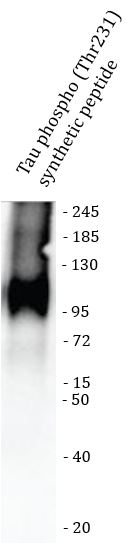
ARG46704 anti-Tau phospho (Thr231) antibody [SQab30388] WB image
Western blot: Tau phospho (Thr231) synthetic peptide stained with ARG46704 anti-Tau phospho (Thr231) antibody [SQab30388].