ARG57177
anti-Thioredoxin Reductase 1 antibody [30F1]
anti-Thioredoxin Reductase 1 antibody [30F1] for ICC/IF,Western blot and Human
Overview
| Product Description | Mouse Monoclonal antibody [30F1] recognizes Thioredoxin Reductase 1 |
|---|---|
| Tested Reactivity | Hu |
| Tested Application | ICC/IF, WB |
| Host | Mouse |
| Clonality | Monoclonal |
| Clone | 30F1 |
| Isotype | IgG2b, kappa |
| Target Name | Thioredoxin Reductase 1 |
| Antigen Species | Human |
| Immunogen | Recombinant fragment around aa. 161-647 of Human Thioredoxin Reductase 1 |
| Conjugation | Un-conjugated |
| Alternate Names | Thioredoxin reductase 1, cytoplasmic; EC 1.8.1.9; Gene associated with retinoic and IFN-induced mortality 12 protein; Gene associated with retinoic and interferon-induced mortality 12 protein; TR; TXNR; TRXR1; KM-102-derived reductase-like factor; TR1; GRIM-12; Thioredoxin reductase TR1 |
Application Instructions
| Application Suggestion |
|
||||||
|---|---|---|---|---|---|---|---|
| Application Note | * The dilutions indicate recommended starting dilutions and the optimal dilutions or concentrations should be determined by the scientist. |
Properties
| Form | Liquid |
|---|---|
| Purification | Purification with Protein A. |
| Buffer | PBS (pH 7.4), 0.02% Sodium azide and 10% Glycerol. |
| Preservative | 0.02% Sodium azide |
| Stabilizer | 10% Glycerol |
| Concentration | 1 mg/ml |
| Storage Instruction | For continuous use, store undiluted antibody at 2-8°C for up to a week. For long-term storage, aliquot and store at -20°C. Storage in frost free freezers is not recommended. Avoid repeated freeze/thaw cycles. Suggest spin the vial prior to opening. The antibody solution should be gently mixed before use. |
| Note | For laboratory research only, not for drug, diagnostic or other use. |
Bioinformation
| Database Links |
Swiss-port # Q16881 Human Thioredoxin reductase 1, cytoplasmic |
|---|---|
| Gene Symbol | TXNRD1 |
| Gene Full Name | thioredoxin reductase 1 |
| Background | This gene encodes a member of the family of pyridine nucleotide oxidoreductases. This protein reduces thioredoxins as well as other substrates, and plays a role in selenium metabolism and protection against oxidative stress. The functional enzyme is thought to be a homodimer which uses FAD as a cofactor. Each subunit contains a selenocysteine (Sec) residue which is required for catalytic activity. The selenocysteine is encoded by the UGA codon that normally signals translation termination. The 3' UTR of selenocysteine-containing genes have a common stem-loop structure, the sec insertion sequence (SECIS), that is necessary for the recognition of UGA as a Sec codon rather than as a stop signal. Alternative splicing results in several transcript variants encoding the same or different isoforms. [provided by RefSeq, Jul 2008] |
| Function | Isoform 1 may possess glutaredoxin activity as well as thioredoxin reductase activity and induces actin and tubulin polymerization, leading to formation of cell membrane protrusions. Isoform 4 enhances the transcriptional activity of estrogen receptors alpha and beta while isoform 5 enhances the transcriptional activity of the beta receptor only. Isoform 5 also mediates cell death induced by a combination of interferon-beta and retinoic acid. [UniProt] |
| Calculated MW | 71 kDa |
| PTM | The N-terminus of isoform 5 is blocked. ISGylated. |
Images (3) Click the Picture to Zoom In
-

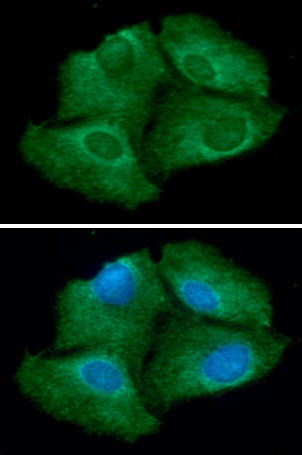
ARG57177 anti-Thioredoxin Reductase 1 antibody [30F1] ICC/IF image
Immunofluorescence: Hep3B cells line stained with ARG57177 anti-Thioredoxin Reductase 1 antibody [30F1] at 1:100 (Green).
DAPI (Blue) for nucleus staining.
-
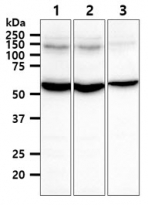
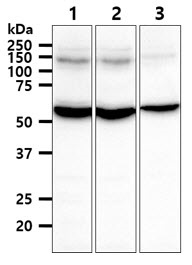
ARG57177 anti-Thioredoxin Reductase 1 antibody [30F1] WB image
Western blot: 40 µg of 1) HeLa, 2) A549, and 3) PC3 cell lysates stained with ARG57177 anti-Thioredoxin Reductase 1 antibody [30F1] at 1:1000.
-
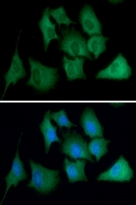
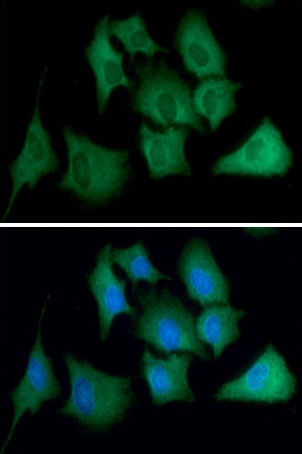
ARG57177 anti-Thioredoxin Reductase 1 antibody [30F1] ICC/IF image
Immunofluorescence: A549 cells line stained with ARG57177 anti-Thioredoxin Reductase 1 antibody [30F1] at 1:100 (Green).
DAPI (Blue) for nucleus staining.