ARG46624
anti-UEV1A antibody
anti-UEV1A antibody for Western blot and Human,Mouse,Rat
Overview
| Product Description | Rabbit Polyclonal antibody recognizes UEV1A |
|---|---|
| Tested Reactivity | Hu, Ms, Rat |
| Tested Application | WB |
| Host | Rabbit |
| Clonality | Polyclonal |
| Isotype | IgG |
| Target Name | UEV1A |
| Antigen Species | Human |
| Immunogen | A 15 amino acid synthetic peptide within the last 50 amino acids of human UEV1A. |
| Conjugation | Un-conjugated |
| Alternate Names | UBE2V1; UEV1A; CIR1; UEV1; CROC1; UBE2V; UEV-1; UEV1A; CROC-1; P/OKcl.19; Ubiquitin-conjugating enzyme E2 variant 1 |
Application Instructions
| Application Suggestion |
|
||||
|---|---|---|---|---|---|
| Application Note | * The dilutions indicate recommended starting dilutions and the optimal dilutions or concentrations should be determined by the scientist. |
Properties
| Form | Liquid |
|---|---|
| Purification | Ion exchange chromatography purified |
| Buffer | PBS and 0.02% Sodium azide. |
| Preservative | 0.02% Sodium azide |
| Concentration | 1 mg/ml |
| Storage Instruction | For continuous use, store undiluted antibody at 2-8°C for up to a week. For long-term storage, aliquot and store at -674°C or below. Storage in frost free freezers is not recommended. Avoid repeated freeze/thaw cycles. Suggest spin the vial prior to opening. The antibody solution should be gently mixed before use. |
| Note | For laboratory research only, not for drug, diagnostic or other use. |
Bioinformation
| Database Links |
Swiss-port # Q13404 Human Ubiquitin-conjugating enzyme E2 variant 1 Swiss-port # Q9CZY3 Mouse Ubiquitin-conjugating enzyme E2 variant 1 |
|---|---|
| Gene Symbol | UBE2V1 |
| Gene Full Name | ubiquitin-conjugating enzyme E2 variant 1 |
| Background | Ubiquitin-conjugating E2 enzyme variant proteins constitute a distinct subfamily within the E2 protein family. They have sequence similarity to other ubiquitin-conjugating enzymes but lack the conserved cysteine residue that is critical for the catalytic activity of E2s. The protein encoded by this gene is located in the nucleus and can cause transcriptional activation of the human FOS proto-oncogene. It is thought to be involved in the control of differentiation by altering cell cycle behavior. Alternatively spliced transcript variants encoding multiple isoforms have been described for this gene, and multiple pseudogenes of this gene have been identified. Co-transcription of this gene and the neighboring upstream gene generates a rare transcript (Kua-UEV), which encodes a fusion protein comprised of sequence sharing identity with each individual gene product. [provided by RefSeq, Apr 2012] |
| Function | Has no ubiquitin ligase activity on its own. The UBE2V1-UBE2N heterodimer catalyzes the synthesis of non-canonical poly-ubiquitin chains that are linked through Lys-63. This type of poly-ubiquitination activates IKK and does not seem to involve protein degradation by the proteasome. Plays a role in the activation of NF-kappa-B mediated by IL1B, TNF, TRAF6 and TRAF2. Mediates transcriptional activation of target genes. Plays a role in the control of progress through the cell cycle and differentiation. Plays a role in the error-free DNA repair pathway and contributes to the survival of cells after DNA damage. Promotes TRIM5 capsid-specific restriction activity and the UBE2V1-UBE2N heterodimer acts in concert with TRIM5 to generate 'Lys-63'-linked polyubiquitin chains which activate the MAP3K7/TAK1 complex which in turn results in the induction and expression of NF-kappa-B and MAPK-responsive inflammatory genes. Together with RNF135 and UBE2N, catalyzes the viral RNA-dependent 'Lys-63'-linked polyubiquitination of RIGI to activate the downstream signaling pathway that leads to interferon beta production (PubMed:31006531). UBE2V1-UBE2N together with TRAF3IP2 E3 ubiquitin ligase mediate 'Lys-63'-linked polyubiquitination of TRAF6, a component of IL17A-mediated signaling pathway. [UniProt] |
| Cellular Localization | Nucleus. [UniProt] |
| Calculated MW | 16 kDa |
| PTM | Ubl conjugation; Acetylation. [UniProt] |
Images (1) Click the Picture to Zoom In
-
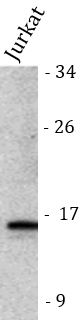
ARG46624 anti-UEV1A antibody WB image
Western blot: Jurkat stained with ARG46624 anti-UEV1A antibody.