ARG46627
anti-ULK2 antibody
anti-ULK2 antibody for Western blot,IHC-Formalin-fixed paraffin-embedded sections and Human
Overview
| Product Description | Rabbit Polyclonal antibody recognizes ULK2 |
|---|---|
| Tested Reactivity | Hu |
| Tested Application | IHC-P, WB |
| Host | Rabbit |
| Clonality | Polyclonal |
| Isotype | IgG |
| Target Name | ULK2 |
| Antigen Species | Human |
| Immunogen | A 17 amino acid synthetic peptide within the last 50 amino acids of human ULK2. |
| Conjugation | Un-conjugated |
| Alternate Names | unc-51-like kinase 2 (C. elegans); ULK2; ATG1B; Unc51.2; KIAA0623; Unc-51-like kinase 2 |
Application Instructions
| Application Suggestion |
|
||||||
|---|---|---|---|---|---|---|---|
| Application Note | * The dilutions indicate recommended starting dilutions and the optimal dilutions or concentrations should be determined by the scientist. | ||||||
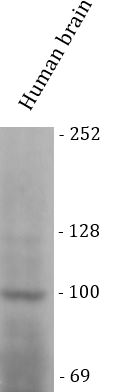
| Observed Size | 100 kDa |
Properties
| Form | Liquid |
|---|---|
| Purification | Affinity chromatography purified |
| Buffer | PBS and 0.02% Sodium azide. |
| Preservative | 0.02% Sodium azide |
| Concentration | 1 mg/ml |
| Storage Instruction | For continuous use, store undiluted antibody at 2-8°C for up to a week. For long-term storage, aliquot and store at -677°C or below. Storage in frost free freezers is not recommended. Avoid repeated freeze/thaw cycles. Suggest spin the vial prior to opening. The antibody solution should be gently mixed before use. |
| Note | For laboratory research only, not for drug, diagnostic or other use. |
Bioinformation
| Database Links |
Swiss-port # Q8IYT8 Human Serine/threonine-protein kinase ULK2 |
|---|---|
| Gene Symbol | ULK2 |
| Gene Full Name | unc-51-like kinase 2 (C. elegans) |
| Background | This gene encodes a protein that is similar to a serine/threonine kinase in C. elegans which is involved in axonal elongation. The structure of this protein is similar to the C. elegans protein in that both proteins have an N-terminal kinase domain, a central proline/serine rich (PS) domain, and a C-terminal (C) domain. The gene is located within the Smith-Magenis syndrome region on chromosome 17. Alternatively spliced transcript variants encoding the same protein have been identified. [provided by RefSeq, Dec 2008] |
| Function | Serine/threonine-protein kinase involved in autophagy in response to starvation. Acts upstream of phosphatidylinositol 3-kinase PIK3C3 to regulate the formation of autophagophores, the precursors of autophagosomes. Part of regulatory feedback loops in autophagy: acts both as a downstream effector and a negative regulator of mammalian target of rapamycin complex 1 (mTORC1) via interaction with RPTOR. Activated via phosphorylation by AMPK, also acts as a negative regulator of AMPK through phosphorylation of the AMPK subunits PRKAA1, PRKAB2 and PRKAG1. May phosphorylate ATG13/KIAA0652, FRS2, FRS3 and RPTOR; however such data need additional evidences. Not involved in ammonia-induced autophagy or in autophagic response of cerebellar granule neurons (CGN) to low potassium concentration. Plays a role early in neuronal differentiation and is required for granule cell axon formation: may govern axon formation via Ras-like GTPase signaling and through regulation of the Rab5-mediated endocytic pathways within developing axons. [UniProt] |
| Cellular Localization | Cytoplasm; Cytoplasmic vesicle; Cytoplasmic vesicle membrane. [UniProt] |
| Calculated MW | 105, 114 kDa |
| PTM | Phosphoprotein. [UniProt] |
Images (2) Click the Picture to Zoom In
-
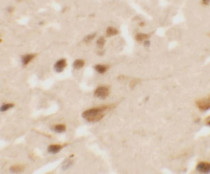
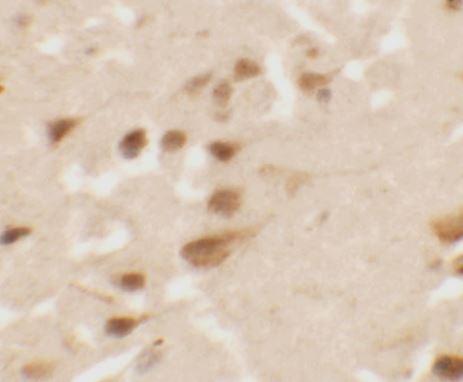
ARG46627 anti-ULK2 antibody IHC-P image
Immunohistochemistry: Human brain stained with ARG46627 anti-ULK2 antibody.
-
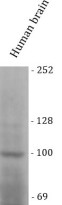
ARG46627 anti-ULK2 antibody WB image
Western blot: Human brain stained with ARG46627 anti-ULK2 antibody.