ARG46630
anti-Uroplakin Ib / UPIb antibody
anti-Uroplakin Ib / UPIb antibody for Western blot,IHC-Formalin-fixed paraffin-embedded sections and Human,Mouse,Rat
Overview
| Product Description | Rabbit Polyclonal antibody recognizes Uroplakin Ib / UPIb |
|---|---|
| Tested Reactivity | Hu, Ms, Rat |
| Tested Application | IHC-P, WB |
| Host | Rabbit |
| Clonality | Polyclonal |
| Isotype | IgG |
| Target Name | Uroplakin Ib / UPIb |
| Antigen Species | Human |
| Immunogen | A 17 amino acid synthetic peptide within the last 50 amino acids of human Uroplakin Ib / UPIb. |
| Conjugation | Un-conjugated |
| Alternate Names | uroplakin 1B; UPK1B; UPIB; UPK1; TSPAN20; Uroplakin-1b; Tetraspanin-20; UP1b |
Application Instructions
| Application Suggestion |
|
||||||
|---|---|---|---|---|---|---|---|
| Application Note | * The dilutions indicate recommended starting dilutions and the optimal dilutions or concentrations should be determined by the scientist. | ||||||
| Observed Size | 30 kDa |
Properties
| Form | Liquid |
|---|---|
| Purification | Affinity chromatography purified |
| Buffer | PBS and 0.02% Sodium azide. |
| Preservative | 0.02% Sodium azide |
| Concentration | 1 mg/ml |
| Storage Instruction | For continuous use, store undiluted antibody at 2-8°C for up to a week. For long-term storage, aliquot and store at -680°C or below. Storage in frost free freezers is not recommended. Avoid repeated freeze/thaw cycles. Suggest spin the vial prior to opening. The antibody solution should be gently mixed before use. |
| Note | For laboratory research only, not for drug, diagnostic or other use. |
Bioinformation
| Database Links | |
|---|---|
| Gene Symbol | UPK1B |
| Gene Full Name | uroplakin 1B |
| Background | The protein encoded by this gene is a member of the transmembrane 4 superfamily, also known as the tetraspanin family. Most of these members are cell-surface proteins that are characterized by the presence of four hydrophobic domains. The proteins mediate signal transduction events that play a role in the regulation of cell development, activation, growth and motility. This encoded protein is found in the asymmetrical unit membrane (AUM) where it can form a complex with other transmembrane 4 superfamily proteins. It may play a role in normal bladder epithelial physiology, possibly in regulating membrane permeability of superficial umbrella cells or in stabilizing the apical membrane through AUM/cytoskeletal interactions. The use of alternate polyadenylation sites has been found for this gene. [provided by RefSeq, Jul 2008] |
| Function | Component of the asymmetric unit membrane (AUM); a highly specialized biomembrane elaborated by terminally differentiated urothelial cells. May play an important role in normal bladder epithelial physiology, possibly in regulating membrane permeability of superficial umbrella cells or in stabilizing the apical membrane through AUM/cytoskeletal interactions (By similarity). [UniProt] |
| Calculated MW | 29 kDa |
| PTM | Glycoprotein. [UniProt] |
Images (2) Click the Picture to Zoom In
-
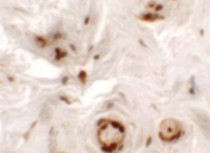
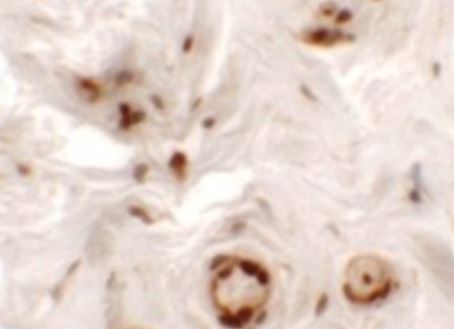
ARG46630 anti-Uroplakin Ib / UPIb antibody IHC-P image
Immunohistochemistry: Human bladder stained with ARG46630 anti-Uroplakin Ib / UPIb antibody.
-
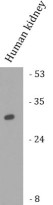
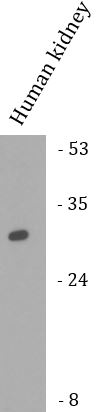
ARG46630 anti-Uroplakin Ib / UPIb antibody WB image
Western blot: Human kidney stained with ARG46630 anti-Uroplakin Ib / UPIb antibody.