ARG46642
anti-WDR35 antibody
anti-WDR35 antibody for IHC-Formalin-fixed paraffin-embedded sections and Human
Overview
| Product Description | Rabbit Polyclonal antibody recognizes WDR35 |
|---|---|
| Tested Reactivity | Hu |
| Tested Application | IHC-P |
| Host | Rabbit |
| Clonality | Polyclonal |
| Isotype | IgG |
| Target Name | WDR35 |
| Antigen Species | Human |
| Immunogen | A 16 amino acid synthetic peptide within the last 50 amino acids of human WDR35. |
| Conjugation | Un-conjugated |
| Alternate Names | WD repeat domain 35; WDR35; CED2; IFTA1; SRTD7; IFT121; KIAA1336; WD repeat-containing protein 35; Intraflagellar transport protein 121 homolog |
Application Instructions
| Application Suggestion |
|
||||
|---|---|---|---|---|---|
| Application Note | * The dilutions indicate recommended starting dilutions and the optimal dilutions or concentrations should be determined by the scientist. |
Properties
| Form | Liquid |
|---|---|
| Purification | Affinity chromatography purified |
| Buffer | PBS and 0.02% Sodium azide. |
| Preservative | 0.02% Sodium azide |
| Concentration | 1 mg/ml |
| Storage Instruction | For continuous use, store undiluted antibody at 2-8°C for up to a week. For long-term storage, aliquot and store at -692°C or below. Storage in frost free freezers is not recommended. Avoid repeated freeze/thaw cycles. Suggest spin the vial prior to opening. The antibody solution should be gently mixed before use. |
| Note | For laboratory research only, not for drug, diagnostic or other use. |
Bioinformation
| Database Links | |
|---|---|
| Gene Symbol | WDR35 |
| Gene Full Name | WD repeat domain 35 |
| Background | This gene encodes a member of the WD repeat protein family. WD repeats are minimally conserved regions of approximately 40 amino acids typically bracketed by gly-his and trp-asp (GH-WD), which may facilitate formation of heterotrimeric or multiprotein complexes. Members of this family are involved in a variety of cellular processes, including cell cycle progression, signal transduction, apoptosis, and gene regulation. Multiple alternatively spliced transcript variants encoding distinct isoforms have been found for this gene. Two patients with Sensenbrenner syndrome / cranioectodermal dysplasia (CED) were identified with mutations in this gene, consistent with a possible ciliary function.[provided by RefSeq, Sep 2010] |
| Function | As a component of the IFT complex A (IFT-A), a complex required for retrograde ciliary transport and entry into cilia of G protein-coupled receptors (GPCRs), it is involved in ciliogenesis and ciliary protein trafficking (PubMed:21473986, PubMed:28400947, PubMed:29220510). May promote CASP3 activation and TNF-stimulated apoptosis. [UniProt] |
| Cellular Localization | Cytoplasm; Cytoskeleton. [UniProt] |
| Calculated MW | 134 kDa |
Images (1) Click the Picture to Zoom In
-
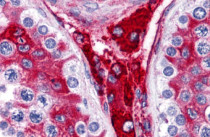
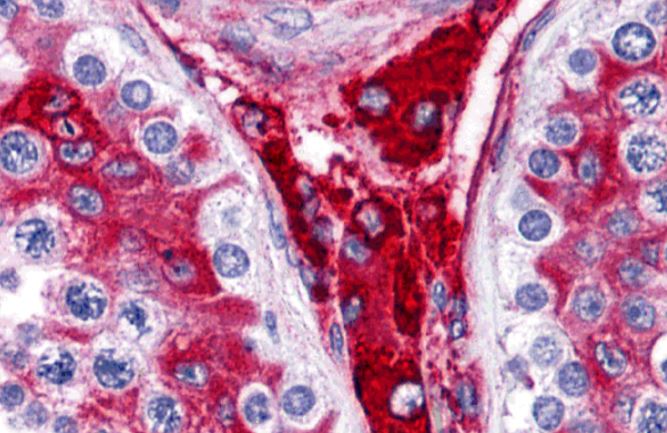
ARG46642 anti-WDR35 antibody IHC-P image
Immunohistochemistry: Human testis stained with ARG46642 anti-WDR35 antibody.