ARG46645
anti-WIPI1 antibody
anti-WIPI1 antibody for Western blot and Human,Mouse,Rat
Overview
| Product Description | Rabbit Polyclonal antibody recognizes WIPI1 |
|---|---|
| Tested Reactivity | Hu, Ms, Rat |
| Tested Application | WB |
| Host | Rabbit |
| Clonality | Polyclonal |
| Isotype | IgG |
| Target Name | WIPI1 |
| Antigen Species | Human |
| Immunogen | A 17 amino acid synthetic peptide within the last 50 amino acids of human WIPI1. |
| Conjugation | Un-conjugated |
| Alternate Names | WD repeat domain, phosphoinositide interacting 1; WIPI1; ATG18; ATG18A; WIPI49; WD repeat domain phosphoinositide-interacting protein 1; Atg18 protein homolog; WIPI-1 |
Application Instructions
| Application Suggestion |
|
||||
|---|---|---|---|---|---|
| Application Note | * The dilutions indicate recommended starting dilutions and the optimal dilutions or concentrations should be determined by the scientist. |
Properties
| Form | Liquid |
|---|---|
| Purification | Affinity chromatography purified |
| Buffer | PBS and 0.02% Sodium azide. |
| Preservative | 0.02% Sodium azide |
| Concentration | 1 mg/ml |
| Storage Instruction | For continuous use, store undiluted antibody at 2-8°C for up to a week. For long-term storage, aliquot and store at -695°C or below. Storage in frost free freezers is not recommended. Avoid repeated freeze/thaw cycles. Suggest spin the vial prior to opening. The antibody solution should be gently mixed before use. |
| Note | For laboratory research only, not for drug, diagnostic or other use. |
Bioinformation
| Database Links |
Swiss-port # Q5MNZ9 Human WD repeat domain phosphoinositide-interacting protein 1 Swiss-port # Q8R3E3 Mouse WD repeat domain phosphoinositide-interacting protein 1 |
|---|---|
| Gene Symbol | WIPI1 |
| Gene Full Name | WD repeat domain, phosphoinositide interacting 1 |
| Background | This gene encodes a WD40 repeat protein. Members of the WD40 repeat family are key components of many essential biologic functions. They regulate the assembly of multiprotein complexes by presenting a beta-propeller platform for simultaneous and reversible protein-protein interactions. Members of the WIPI subfamily of WD40 repeat proteins have a 7-bladed propeller structure and contain a conserved motif for interaction with phospholipids. Alternative splicing results in multiple transcript variants. [provided by RefSeq, Mar 2016] |
| Function | Component of the autophagy machinery that controls the major intracellular degradation process by which cytoplasmic materials are packaged into autophagosomes and delivered to lysosomes for degradation (PubMed:15602573, PubMed:20114074, PubMed:20484055, PubMed:20639694, PubMed:23088497, PubMed:28561066, PubMed:31271352). Plays an important role in starvation- and calcium-mediated autophagy, as well as in mitophagy (PubMed:28561066). Functions downstream of the ULK1 and PI3-kinases that produce phosphatidylinositol 3-phosphate (PtdIns3P) on membranes of the endoplasmic reticulum once activated (PubMed:28561066). Binds phosphatidylinositol 3-phosphate (PtdIns3P), and maybe other phosphoinositides including PtdIns3,5P2 and PtdIns5P, and is recruited to phagophore assembly sites at the endoplasmic reticulum membranes (PubMed:28561066, PubMed:31271352, PubMed:33499712). There, it assists WIPI2 in the recruitment of ATG12-ATG5-ATG16L1, a complex that directly controls the elongation of the nascent autophagosomal membrane (PubMed:28561066). Together with WDR45/WIPI4, promotes ATG2 (ATG2A or ATG2B)-mediated lipid transfer by enhancing ATG2-association with phosphatidylinositol 3-monophosphate (PI3P)-containing membranes (PubMed:31271352). Involved in xenophagy of Staphylococcus aureus (PubMed:22829830). Invading S.aureus cells become entrapped in autophagosome-like WIPI1 positive vesicles targeted for lysosomal degradation (PubMed:22829830). Also plays a distinct role in controlling the transcription of melanogenic enzymes and melanosome maturation, a process that is distinct from starvation-induced autophagy (PubMed:21317285). May also regulate the trafficking of proteins involved in the mannose-6-phosphate receptor (MPR) recycling pathway (PubMed:15020712). [UniProt] |
| Cellular Localization | Cytoplasm; Nucleus; Cytoskeleton; Endosome; Cytoplasmic vesicle; Golgi apparatus. [UniProt] |
| Calculated MW | 49 kDa |
Images (1) Click the Picture to Zoom In
-
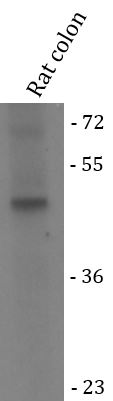
ARG46645 anti-WIPI1 antibody WB image
Western blot: Rat colon stained with ARG46645 anti-WIPI1 antibody.