ARG46651
anti-XKR8 antibody
anti-XKR8 antibody for Western blot,IHC-Formalin-fixed paraffin-embedded sections and Human
Overview
| Product Description | Rabbit Polyclonal antibody recognizes XKR8 |
|---|---|
| Tested Reactivity | Hu |
| Tested Application | IHC-P, WB |
| Host | Rabbit |
| Clonality | Polyclonal |
| Isotype | IgG |
| Target Name | XKR8 |
| Antigen Species | Human |
| Immunogen | A 15 amino acid synthetic peptide within the last 50 amino acids of human XKR8. |
| Conjugation | Un-conjugated |
| Alternate Names | XK, Kell blood group complex subunit-related family, member 8; XKR8; XRG8; hXkr8; XRG8; XK-related protein 8 |
Application Instructions
| Application Suggestion |
|
||||||
|---|---|---|---|---|---|---|---|
| Application Note | * The dilutions indicate recommended starting dilutions and the optimal dilutions or concentrations should be determined by the scientist. | ||||||
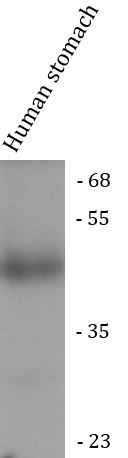
| Observed Size | 47 kDa |
Properties
| Form | Liquid |
|---|---|
| Purification | Affinity chromatography purified |
| Buffer | PBS and 0.02% Sodium azide. |
| Preservative | 0.02% Sodium azide |
| Concentration | 1 mg/ml |
| Storage Instruction | For continuous use, store undiluted antibody at 2-8°C for up to a week. For long-term storage, aliquot and store at -701°C or below. Storage in frost free freezers is not recommended. Avoid repeated freeze/thaw cycles. Suggest spin the vial prior to opening. The antibody solution should be gently mixed before use. |
| Note | For laboratory research only, not for drug, diagnostic or other use. |
Bioinformation
| Database Links | |
|---|---|
| Gene Symbol | XKR8 |
| Gene Full Name | XK, Kell blood group complex subunit-related family, member 8 |
| Background | Enables phospholipid scramblase activity. Involved in engulfment of apoptotic cell; phosphatidylserine exposure on apoptotic cell surface; and positive regulation of myoblast differentiation. Located in plasma membrane. [provided by Alliance of Genome Resources, Jul 2025] |
| Function | [XK-related protein 8, processed form]: Phospholipid scramblase that promotes phosphatidylserine exposure on apoptotic cell surface (PubMed:23845944, PubMed:25231987). Phosphatidylserine is a specific marker only present at the surface of apoptotic cells and acts as a specific signal for engulfment (PubMed:23845944). Required for the clearance of apoptotic cells, such as engulfment of apoptotic germ cells by Sertoli cells, clearance of senescent neutrophils or regulation of bipolar cell numbers in the retina (By similarity). Has no effect on calcium-induced exposure of phosphatidylserine (PubMed:23845944). Promotes myoblast differentiation and survival (PubMed:28881496). [UniProt] |
| Cellular Localization | Cytoplasm; Cell membrane; Cell membrane . [UniProt] |
| Calculated MW | 43 kDa |
| PTM | Phosphoprotein. [UniProt] |
Images (2) Click the Picture to Zoom In
-
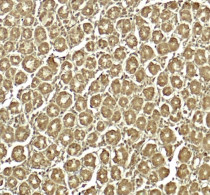
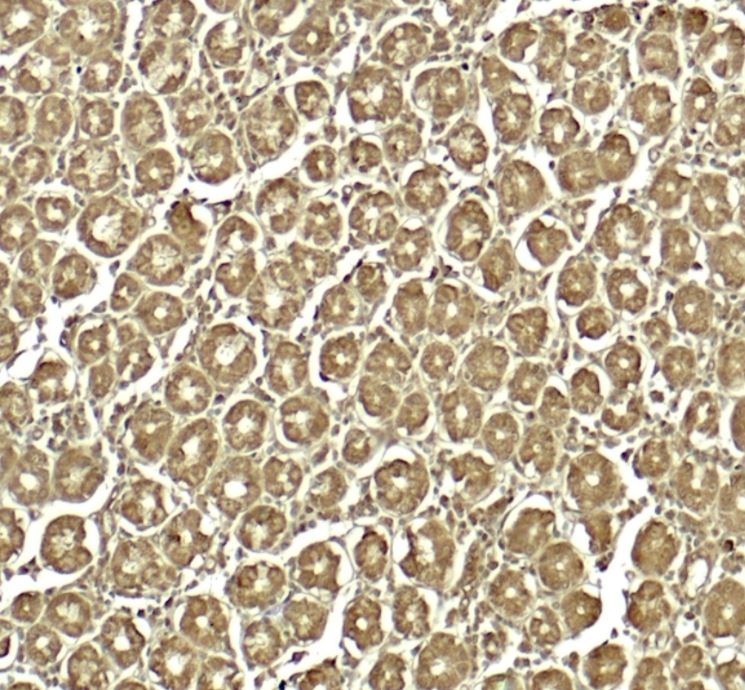
ARG46651 anti-XKR8 antibody IHC-P image
Immunohistochemistry: Human stomach stained with ARG46651 anti-XKR8 antibody.
-
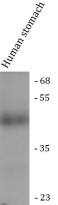
ARG46651 anti-XKR8 antibody WB image
Western blot: Human stomach stained with ARG46651 anti-XKR8 antibody.