ARG67339
anti-ZAK antibody
anti-ZAK antibody for IHC-Formalin-fixed paraffin-embedded sections,Western blot and Human,Mouse,Rat
Overview
| Product Description | Rabbit Polyclonal antibody recognizes ZAK |
|---|---|
| Tested Reactivity | Hu, Ms, Rat |
| Tested Application | IHC-P, WB |
| Host | Rabbit |
| Clonality | Polyclonal |
| Isotype | IgG |
| Target Name | ZAK |
| Antigen Species | Human |
| Immunogen | Recombinant fusion protein of human ZAK. |
| Conjugation | Un-conjugated |
| Alternate Names | AZK; MLK-related kinase; mlklak; EC 2.7.11.25; MLK7; MLK-like mitogen-activated protein triple kinase; MLTK; Human cervical cancer suppressor gene 4 protein; HCCS-4; MLT; MRK; Mitogen-activated protein kinase kinase kinase MLT; pk; Sterile alpha motif- and leucine zipper-containing kinase AZK; Leucine zipper- and sterile alpha motif-containing kinase; Mixed lineage kinase-related kinase |
Application Instructions
| Application Suggestion |
|
||||||
|---|---|---|---|---|---|---|---|
| Application Note | * The dilutions indicate recommended starting dilutions and the optimal dilutions or concentrations should be determined by the scientist. | ||||||
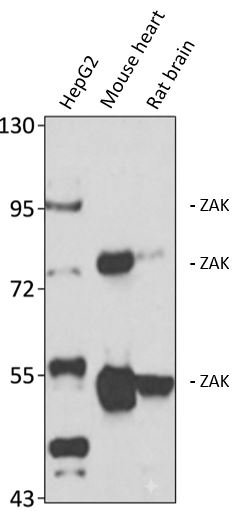
| Observed Size | 55; 71; 100 kDa |
Properties
| Form | Liquid |
|---|---|
| Purification | Affinity purification with immunogen |
| Purification Note | 0.42% Potassium phosphate (pH 7.3), 0.87% NaCl, 0.01% Sodium azide and 30% Glycerol. |
| Purity | 0.01% Sodium azide |
| Buffer | 30% Glycerol |
| Storage Instruction | For continuous use, store undiluted antibody at 2-8°C for up to a week. For long-term storage, aliquot and store at -20°C or below. Storage in frost free freezers is not recommended. Avoid repeated freeze/thaw cycles. Suggest spin the vial prior to opening. The antibody solution should be gently mixed before use. |
| Note | For laboratory research only, not for drug, diagnostic or other use. |
Bioinformation
| Gene Symbol | ZAK |
|---|---|
| Gene Full Name | sterile alpha motif and leucine zipper containing kinase AZK |
| Background | This gene is a member of the MAPKKK family of signal transduction molecules and encodes a protein with an N-terminal kinase catalytic domain, followed by a leucine zipper motif and a sterile-alpha motif (SAM). This magnesium-binding protein forms homodimers and is located in the cytoplasm. The protein mediates gamma radiation signaling leading to cell cycle arrest and activity of this protein plays a role in cell cycle checkpoint regulation in cells. The protein also has pro-apoptotic activity. Alternate transcriptional splice variants, encoding different isoforms, have been characterized. [provided by RefSeq, Jul 2008] |
| Function | Stress-activated component of a protein kinase signal transduction cascade. Regulates the JNK and p38 pathways. Pro-apoptotic. Role in regulation of S and G2 cell cycle checkpoint by direct phosphorylation of CHEK2. Isoform 1, but not isoform 2, causes cell shrinkage and disruption of actin stress fibers. Isoform 1 may have role in neoplastic cell transformation and cancer development. Isoform 1, but not isoform 2, phosphorylates histone H3 at 'Ser-28'. [UniProt] |
| Cellular Localization | Cytoplasm. Nucleus. Note=Translocates to the nucleus upon ultraviolet B irradiation. [UniProt] |
| Calculated MW | 35; 51; 91 kDa |
Images (3) Click the Picture to Zoom In
-
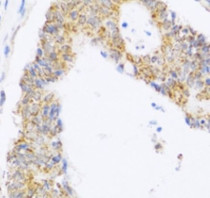
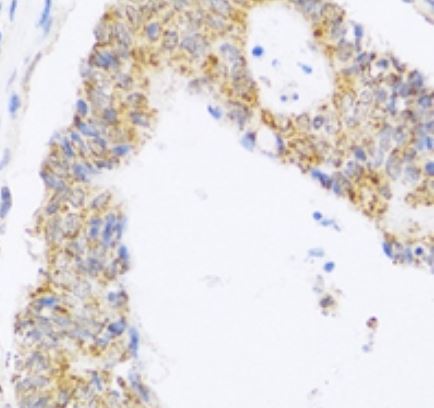
ARG67339 anti-ZAK antibody IHC-P image
Immunohistochemistry: Human colon cancer stained with ARG67339 anti-ZAK antibody.
-
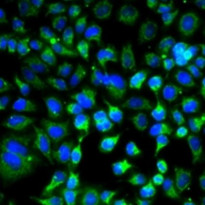
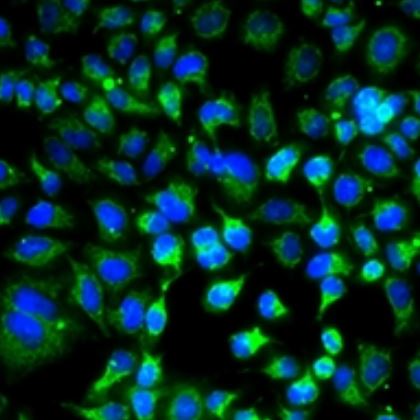
ARG67339 anti-ZAK antibody ICC/IF image
Immunofluorescence: A549 stained with ARG67339 anti-ZAK antibody.
-
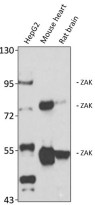
ARG67339 anti-ZAK antibody WB image
Western blot: HepG2, mouse heart and rat brain stained with ARG67339 anti-ZAK antibody.