ARG46658
anti-ZBED1 antibody
anti-ZBED1 antibody for Western blot and Human,Mouse
Overview
| Product Description | Rabbit Polyclonal antibody recognizes ZBED1 |
|---|---|
| Tested Reactivity | Hu, Ms |
| Tested Application | WB |
| Host | Rabbit |
| Clonality | Polyclonal |
| Isotype | IgG |
| Target Name | ZBED1 |
| Antigen Species | Human |
| Immunogen | A 15 amino acid synthetic peptide within the last 50 amino acids of human ZBED1. |
| Conjugation | Un-conjugated |
| Alternate Names | zinc finger, BED-type containing 1; ZBED1; ALTE; DREF; TRAMP; hDREF; ALTE; KIAA0785; Zinc finger BED domain-containing protein 1; Putative Ac-like transposable element |
Application Instructions
| Application Suggestion |
|
||||
|---|---|---|---|---|---|
| Application Note | * The dilutions indicate recommended starting dilutions and the optimal dilutions or concentrations should be determined by the scientist. |
Properties
| Form | Liquid |
|---|---|
| Purification | Affinity chromatography purified |
| Buffer | PBS and 0.02% Sodium azide. |
| Preservative | 0.02% Sodium azide |
| Concentration | 1 mg/ml |
| Storage Instruction | For continuous use, store undiluted antibody at 2-8°C for up to a week. For long-term storage, aliquot and store at -708°C or below. Storage in frost free freezers is not recommended. Avoid repeated freeze/thaw cycles. Suggest spin the vial prior to opening. The antibody solution should be gently mixed before use. |
| Note | For laboratory research only, not for drug, diagnostic or other use. |
Bioinformation
| Database Links |
Swiss-port # O96006 Human Zinc finger BED domain-containing protein 1 |
|---|---|
| Gene Symbol | ZBED1 |
| Gene Full Name | zinc finger, BED-type containing 1 |
| Background | This gene is located in the pseudoautosomal region 1 (PAR1) of X and Y chromosomes. It was earlier identified as a gene with similarity to Ac transposable elements, however, was found not to have transposase activity. Later studies show that this gene product is localized in the nucleus and functions as a transcription factor. It binds to DNA elements found in the promoter regions of several genes related to cell proliferation, such as histone H1, hence may have a role in regulating genes related to cell proliferation. Alternatively spliced transcript variants with different 5' untranslated region have been found for this gene. [provided by RefSeq, Jan 2010] |
| Function | Functions as an E3-type small ubiquitin-like modifier (SUMO) ligase which sumoylates CHD3/Mi2-alpha, causing its release from DNA (PubMed:27068747). This results in suppression of CHD3/Mi2-alpha transcription repression, increased recruitment of RNA polymerase II to gene promoters and positive regulation of transcription including H1-5 and ribosomal proteins such as: RPS6, RPL10A, and RPL12 (PubMed:12663651, PubMed:17209048, PubMed:17220279, PubMed:27068747). The resulting increased transcriptional activity drives cell proliferation (PubMed:12663651, PubMed:17220279). Binds to 5'-TGTCG[CT]GA[CT]A-3' consensus sequences in gene promoters of ribosomal proteins (PubMed:12663651, PubMed:17209048, PubMed:17220279, PubMed:27068747). [UniProt] |
| Cellular Localization | Nucleus. [UniProt] |
| Calculated MW | 78 kDa |
| PTM | Ubl conjugation. [UniProt] |
Images (1) Click the Picture to Zoom In
-
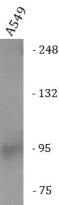
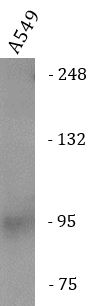
ARG46658 anti-ZBED1 antibody WB image
Western blot: A549 stained with ARG46658 anti-ZBED1 antibody.