ARG46660
anti-ZBED3 antibody
anti-ZBED3 antibody for Western blot and Human,Mouse,Rat
Overview
| Product Description | Rabbit Polyclonal antibody recognizes ZBED3 |
|---|---|
| Tested Reactivity | Hu, Ms, Rat |
| Tested Application | WB |
| Host | Rabbit |
| Clonality | Polyclonal |
| Isotype | IgG |
| Target Name | ZBED3 |
| Antigen Species | Human |
| Immunogen | A 17 amino acid synthetic peptide within the last 50 amino acids of human ZBED3. |
| Conjugation | Un-conjugated |
| Alternate Names | zinc finger, BED-type containing 3; ZBED3; Zinc finger BED domain-containing protein 3; Axin-interacting protein |
Application Instructions
| Application Suggestion |
|
||||
|---|---|---|---|---|---|
| Application Note | * The dilutions indicate recommended starting dilutions and the optimal dilutions or concentrations should be determined by the scientist. | ||||
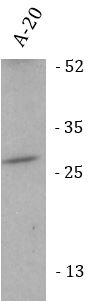
| Observed Size | 28 kDa |
Properties
| Form | Liquid |
|---|---|
| Purification | Affinity chromatography purified |
| Buffer | PBS and 0.02% Sodium azide. |
| Preservative | 0.02% Sodium azide |
| Concentration | 1 mg/ml |
| Storage Instruction | For continuous use, store undiluted antibody at 2-8°C for up to a week. For long-term storage, aliquot and store at -710°C or below. Storage in frost free freezers is not recommended. Avoid repeated freeze/thaw cycles. Suggest spin the vial prior to opening. The antibody solution should be gently mixed before use. |
| Note | For laboratory research only, not for drug, diagnostic or other use. |
Bioinformation
| Database Links |
Swiss-port # Q96IU2 Human Zinc finger BED domain-containing protein 3 Swiss-port # Q9D0L1 Mouse Zinc finger BED domain-containing protein 3 |
|---|---|
| Gene Symbol | ZBED3 |
| Gene Full Name | zinc finger, BED-type containing 3 |
| Background | This gene belongs to a class of genes that arose through hAT DNA transposition and that encode regulatory proteins. This gene is upregulated in lung cancer tissues, where the encoded protein causes an accumulation of beta-catenin and enhanced lung cancer cell invasion. In addition, the encoded protein can be secreted and be involved in resistance to insulin. [provided by RefSeq, Jul 2016] |
| Function | Acts as a positive regulator in the activation of the canonical Wnt/beta-catenin signaling pathway by stabilizing cytoplasmic beta-catenin (By similarity). Involved in transcription activation of Wnt target gene expression (By similarity). Plays a role in symmetric division of blastomeres in the early stages of embryogenesis via regulation of mitotic spindle central positioning and organization of the F-actin filament network (By similarity). Plays a role in regulating the distribution of cellular organelles, via modulation of cytoskeletal dynamics and cytoplasmic lattice formation (By similarity). [UniProt] |
| Cellular Localization | Secreted; Cytoplasm. [UniProt] |
| Calculated MW | 26 kDa |
Images (1) Click the Picture to Zoom In
-
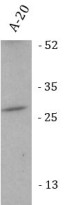
ARG46660 anti-ZBED3 antibody WB image
Western blot: A-20 stained with ARG46660 anti-ZBED3 antibody.