ARG46691
anti-ZIP9 antibody
anti-ZIP9 antibody for Western blot,IHC-Formalin-fixed paraffin-embedded sections and Human,Mouse
Overview
| Product Description | Rabbit Polyclonal antibody recognizes ZIP9 |
|---|---|
| Tested Reactivity | Hu, Ms |
| Tested Application | IHC-P, WB |
| Host | Rabbit |
| Clonality | Polyclonal |
| Isotype | IgG |
| Target Name | ZIP9 |
| Antigen Species | Human |
| Immunogen | A 18 amino acid synthetic peptide within the last 50 amino acids of human ZIP9. |
| Conjugation | Un-conjugated |
| Alternate Names | Slc39a9; solute carrier family 39 (zinc transporter), member 9; ZIP9; ZIP9; ZIP-9; ZIP9; UNQ714/PRO1377; Zinc transporter ZIP9; Solute carrier family 39 member 9 |
Application Instructions
| Application Suggestion |
|
||||||
|---|---|---|---|---|---|---|---|
| Application Note | * The dilutions indicate recommended starting dilutions and the optimal dilutions or concentrations should be determined by the scientist. |
Properties
| Form | Liquid |
|---|---|
| Purification | Affinity chromatography purified |
| Buffer | PBS and 0.02% Sodium azide. |
| Preservative | 0.02% Sodium azide |
| Concentration | 1 mg/ml |
| Storage Instruction | For continuous use, store undiluted antibody at 2-8°C for up to a week. For long-term storage, aliquot and store at -741°C or below. Storage in frost free freezers is not recommended. Avoid repeated freeze/thaw cycles. Suggest spin the vial prior to opening. The antibody solution should be gently mixed before use. |
| Note | For laboratory research only, not for drug, diagnostic or other use. |
Bioinformation
| Database Links | |
|---|---|
| Gene Symbol | Slc39a9 |
| Gene Full Name | solute carrier family 39 (zinc transporter), member 9 |
| Background | Enables G protein-coupled receptor activity; androgen binding activity; and zinc efflux transmembrane transporter activity. Involved in intracellular zinc ion homeostasis; regulation of vascular endothelial cell proliferation; and zinc ion transmembrane transport. Located in several cellular components, including mitochondrial membrane; perinuclear region of cytoplasm; and trans-Golgi network. [provided by Alliance of Genome Resources, Jul 2025] |
| Function | Transports zinc ions across cell and organelle membranes into the cytoplasm and regulates intracellular zinc homeostasis (PubMed:19420709, PubMed:25014355, PubMed:28219737). Participates in the zinc ions efflux out of the secretory compartments (PubMed:19420709). Regulates intracellular zinc level, resulting in the enhancement of AKT1 and MAPK3/MAPK1 (Erk1/2) phosphorylation in response to the BCR activation (PubMed:23505453). Also functions as a membrane androgen receptor that mediates, through a G protein, the non-classical androgen signaling pathway, characterized by the activation of MAPK3/MAPK1 (Erk1/2) and transcription factors CREB1 or ATF1 (By similarity). This pathway contributes to CLDN1 and CLDN5 expression and tight junction formation between adjacent Sertoli cells (By similarity). Mediates androgen-induced vascular endothelial cell proliferation through activation of an inhibitory G protein leading to the AKT1 and MAPK3/MAPK1 (Erk1/2) activation which in turn modulate inhibition (phosphorylation) of GSK3B and CCND1 transcription (PubMed:34555425). Moreover, has dual functions as a membrane-bound androgen receptor and as an androgen-dependent zinc transporter both of which are mediated through an inhibitory G protein (Gi) that mediates both MAP kinase and zinc signaling leading to the androgen-dependent apoptotic process (PubMed:25014355, PubMed:28219737). [UniProt] |
| Cellular Localization | Cytoplasm; Nucleus; Cell membrane; Golgi apparatus; Cell membrane . [UniProt] |
| Calculated MW | 32 kDa |
| PTM | Glycoprotein. [UniProt] |
Images (2) Click the Picture to Zoom In
-
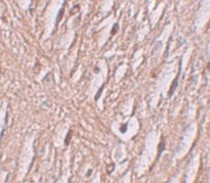
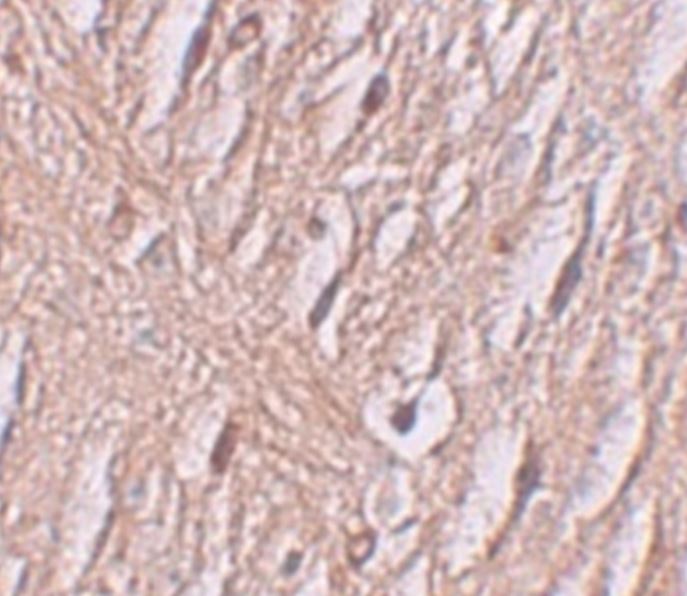
ARG46691 anti-ZIP9 antibody IHC-P image
Immunohistochemistry: Human brain stained with ARG46691 anti-ZIP9 antibody.
-
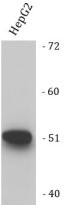
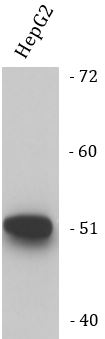
ARG46691 anti-ZIP9 antibody WB image
Western blot: HepG2 stained with ARG46691 anti-ZIP9 antibody.