ARG46696
anti-ZNF346 antibody
anti-ZNF346 antibody for Western blot and Human,Mouse,Rat
Overview
| Product Description | Rabbit Polyclonal antibody recognizes ZNF346 |
|---|---|
| Tested Reactivity | Hu, Ms, Rat |
| Tested Application | WB |
| Host | Rabbit |
| Clonality | Polyclonal |
| Isotype | IgG |
| Target Name | ZNF346 |
| Antigen Species | Human |
| Immunogen | A 20 amino acid synthetic peptide within the last 50 amino acids of human ZNF346. |
| Conjugation | Un-conjugated |
| Alternate Names | ZNF346; JAZ; Zfp346; JAZ; Zinc finger protein 346; Just another zinc finger protein |
Application Instructions
| Application Suggestion |
|
||||
|---|---|---|---|---|---|
| Application Note | * The dilutions indicate recommended starting dilutions and the optimal dilutions or concentrations should be determined by the scientist. |
Properties
| Form | Liquid |
|---|---|
| Purification | Affinity chromatography purified |
| Buffer | PBS and 0.02% Sodium azide. |
| Preservative | 0.02% Sodium azide |
| Concentration | 1 mg/ml |
| Storage Instruction | For continuous use, store undiluted antibody at 2-8°C for up to a week. For long-term storage, aliquot and store at -746°C or below. Storage in frost free freezers is not recommended. Avoid repeated freeze/thaw cycles. Suggest spin the vial prior to opening. The antibody solution should be gently mixed before use. |
| Note | For laboratory research only, not for drug, diagnostic or other use. |
Bioinformation
| Database Links | |
|---|---|
| Gene Symbol | ZNF346 |
| Gene Full Name | zinc finger protein 346 |
| Background | The protein encoded by this gene is a nucleolar, zinc finger protein that preferentially binds to double-stranded (ds) RNA or RNA/DNA hybrids, rather than DNA alone. Mutational studies indicate that the zinc finger domains are not only essential for dsRNA binding, but are also required for its nucleolar localization. The encoded protein may be involved in cell growth and survival. It plays a role in protecting neurons by inhibiting cell cycle re-entry via stimulation of p21 gene expression. Alternative splicing of this gene results in multiple transcript variants. [provided by RefSeq, Apr 2015] |
| Function | Binds with low affinity to dsDNA and ssRNA, and with high affinity to dsRNA, with no detectable sequence specificity (PubMed:24521053). May bind to specific miRNA hairpins (PubMed:28431233). [UniProt] |
| Cellular Localization | Cytoplasm; Nucleus. [UniProt] |
| Calculated MW | 33 kDa |
| PTM | Isopeptide bond; Ubl conjugation; Acetylation. [UniProt] |
Images (1) Click the Picture to Zoom In
-
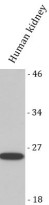
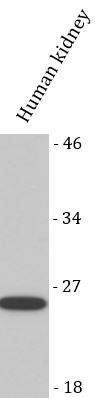
ARG46696 anti-ZNF346 antibody WB image
Western blot: Human kidney stained with ARG46696 anti-ZNF346 antibody.