ARG54654
anti-p53DINP1 antibody
anti-p53DINP1 antibody for ELISA,IHC-Formalin-fixed paraffin-embedded sections,Western blot and Human,Mouse,Rat
Cancer antibody; Cell Biology and Cellular Response antibody; Cell Death antibody
Overview
| Product Description | Rabbit Polyclonal antibody recognizes p53DINP1 |
|---|---|
| Tested Reactivity | Hu, Ms, Rat |
| Tested Application | ELISA, IHC-P, WB |
| Specificity | At least two isoforms of p53DINP1 are known to exist; this antibody will detect both isoforms. |
| Host | Rabbit |
| Clonality | Polyclonal |
| Isotype | IgG |
| Target Name | p53DINP1 |
| Immunogen | Synthetic peptide (14 aa) within the first 50 aa of Human p53DINP1. |
| Conjugation | Un-conjugated |
| Alternate Names | TP53DINP1; SIP; p53DINP1; Teap; Stress-induced protein; Tumor protein p53-inducible nuclear protein 1; p53-dependent damage-inducible nuclear protein 1; TP53INP1A; TP53INP1B |
Application Instructions
| Application Suggestion |
|
||||||||
|---|---|---|---|---|---|---|---|---|---|
| Application Note | * The dilutions indicate recommended starting dilutions and the optimal dilutions or concentrations should be determined by the scientist. | ||||||||
| Positive Control | Human Lung Tissue Lysate | ||||||||
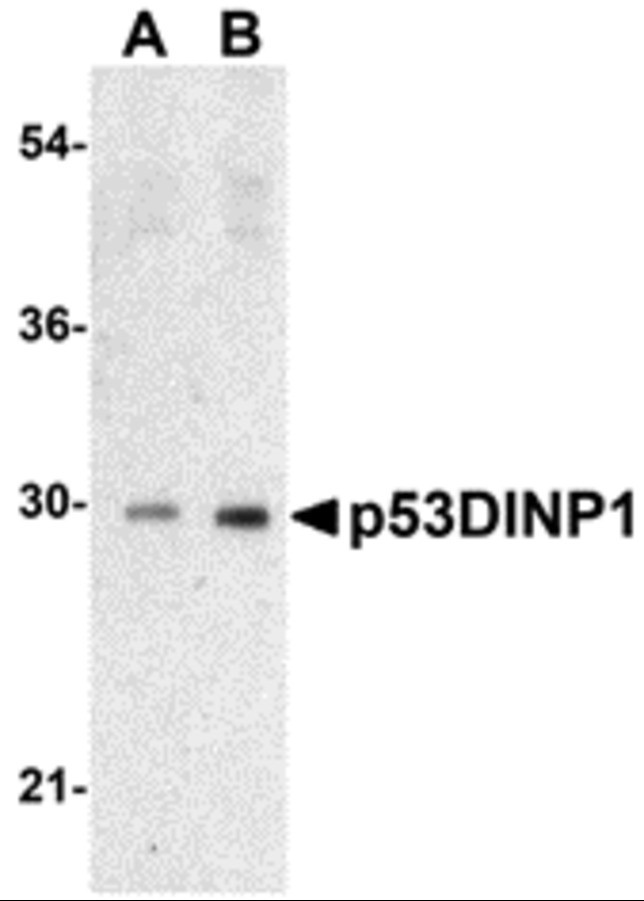
| Observed Size | 30 kDa |
Properties
| Form | Liquid |
|---|---|
| Purification | Affinity purification with immunogen. |
| Buffer | PBS and 0.02% Sodium azide |
| Preservative | 0.02% Sodium azide |
| Concentration | 1 mg/ml |
| Storage Instruction | For continuous use, store undiluted antibody at 2-8°C for up to a week. For long-term storage, aliquot and store at -20°C or below. Storage in frost free freezers is not recommended. Avoid repeated freeze/thaw cycles. Suggest spin the vial prior to opening. The antibody solution should be gently mixed before use. |
| Note | For laboratory research only, not for drug, diagnostic or other use. |
Bioinformation
| Database Links |
Swiss-port # Q80YE2 Rat Tumor protein p53-inducible nuclear protein 1 Swiss-port # Q96A56 Human Tumor protein p53-inducible nuclear protein 1 |
|---|---|
| Gene Symbol | TP53INP1 |
| Gene Full Name | tumor protein p53 inducible nuclear protein 1 |
| Background | p53DINP1 Antibody: Apoptosis is related to many diseases and development. The p53 tumor-suppressor protein induces apoptosis through transcriptional activation of several genes. A novel p53 inducible gene was identified recently and designated p53DINP1 (for p53-dependent damage-inducible nuclear protein 1) and SIP (for stress induced protein) in human and mouse. A p53DINP1 antisense oligonucleotide inhibits and overexpression of p53DINP1 enhances Ser46 phosphorylation of p53, induction of p53AIP1, and cell death induced by DNA double-strand breaks. p53DINP1 may regulate p53-dependent apoptosis through phosphorylation at Ser46 and induction of p53AIP1. The p53DINP1/SIP gene encodes two proteins of 27 and 18 kDa in human and mouse termed p53DINP1-alpha and p53DINP1-beta or SIP27 and SIP18. p53DINP1/SIP is expressed in many tissues and induced by a variety of stress agents including UV stress, mutagenic stress, heat shock, and oxidative stress. | |
| Research Area | Cancer antibody; Cell Biology and Cellular Response antibody; Cell Death antibody |
| Calculated MW | 18, 27 kDa |
Images (2) Click the Picture to Zoom In
-
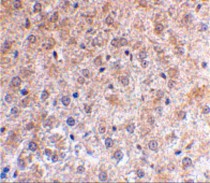
ARG54654 anti-p53DINP1 antibody IHC image
Immunohistochemistry: mouse liver stained with ARG54654 anti-p53DINP1 antibody at 2 μg/ml.
-
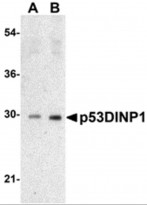
ARG54654 anti-p53DINP1 antibody WB image
Western blot: human lung tissue lysate stained with ARG54654 anti-p53DINP1 antibody at (A) 0.5 and (B) 1 μg/ml.