ARG40871
anti-tPA antibody
anti-tPA antibody for IHC-Formalin-fixed paraffin-embedded sections,Western blot and Human,Mouse,Rat
Overview
| Product Description | Rabbit Polyclonal antibody recognizes tPA |
|---|---|
| Tested Reactivity | Hu, Ms, Rat |
| Tested Application | IHC-P, WB |
| Host | Rabbit |
| Clonality | Polyclonal |
| Isotype | IgG |
| Target Name | tPA |
| Antigen Species | Human |
| Immunogen | Synthetic peptide derived from Human tPA. |
| Conjugation | Un-conjugated |
| Alternate Names | TPA; tPA; T-PA; t-plasminogen activator; t-PA; Tissue-type plasminogen activator; EC 3.4.21.68; Reteplase; Alteplase |
Application Instructions
| Application Suggestion |
|
||||||
|---|---|---|---|---|---|---|---|
| Application Note | * The dilutions indicate recommended starting dilutions and the optimal dilutions or concentrations should be determined by the scientist. |
Properties
| Form | Liquid |
|---|---|
| Purification | Affinity purified. |
| Buffer | PBS (pH 7.4), 150 mM NaCl, 0.02% Sodium azide and 50% Glycerol. |
| Preservative | 0.02% Sodium azide |
| Stabilizer | 50% Glycerol |
| Storage Instruction | For continuous use, store undiluted antibody at 2-8°C for up to a week. For long-term storage, aliquot and store at -20°C. Storage in frost free freezers is not recommended. Avoid repeated freeze/thaw cycles. Suggest spin the vial prior to opening. The antibody solution should be gently mixed before use. |
| Note | For laboratory research only, not for drug, diagnostic or other use. |
Bioinformation
| Database Links | |
|---|---|
| Gene Symbol | PLAT |
| Gene Full Name | plasminogen activator, tissue |
| Background | This gene encodes tissue-type plasminogen activator, a secreted serine protease which converts the proenzyme plasminogen to plasmin, a fibrinolytic enzyme. Tissue-type plasminogen activator is synthesized as a single chain which is cleaved by plasmin to a two chain disulfide linked protein. This enzyme plays a role in cell migration and tissue remodeling. Increased enzymatic activity causes hyperfibrinolysis, which manifests as excessive bleeding; decreased activity leads to hypofibrinolysis which can result in thrombosis or embolism. Alternative splicing of this gene results in multiple transcript variants encoding different isoforms. [provided by RefSeq, Jul 2008] |
| Function | Converts the abundant, but inactive, zymogen plasminogen to plasmin by hydrolyzing a single Arg-Val bond in plasminogen. By controlling plasmin-mediated proteolysis, it plays an important role in tissue remodeling and degradation, in cell migration and many other physiopathological events. Plays a direct role in facilitating neuronal migration. [UniProt] |
| Cellular Localization | Secreted, extracellular space. [UniProt] |
| Calculated MW | 63 kDa |
| PTM | The single chain, almost fully active enzyme, can be further processed into a two-chain fully active form by a cleavage after Arg-310 catalyzed by plasmin, tissue kallikrein or factor Xa. Differential cell-specific N-linked glycosylation gives rise to two glycoforms, type I (glycosylated at Asn-219) and type II (not glycosylated at Asn-219). The single chain type I glycoform is less readily converted into the two-chain form by plasmin, and the two-chain type I glycoform has a lower activity than the two-chain type II glycoform in the presence of fibrin. N-glycosylation of Asn-152; the bound oligomannosidic glycan is involved in the interaction with the mannose receptor. Characterization of O-linked glycan was studied in Bowes melanoma cell line. [UniProt] |
Images (1) Click the Picture to Zoom In
-
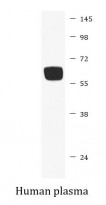
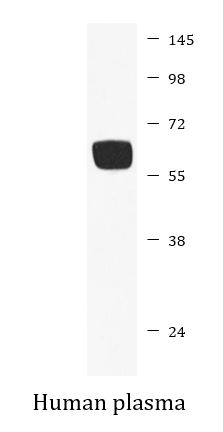
ARG40871 anti-tPA antibody WB image
Western blot: Human plasma lysate stained with ARG40871 anti-tPA antibody.