ARG83825
arigoPLEX® Human MMP Multiplex ELISA Kit (MMP1, MMP2, MMP3, MMP9)
Overview
| Product Description | ARG83825 arigoPLEX® Human MMP Multiplex ELISA Kit (MMP1, MMP2, MMP3, MMP9) is an Enzyme Immunoassay kit for the quantification of Human MMP in serum, plasma and cell culture supernatants. See all Multiplex ELISA kits |
|---|---|
| Tested Reactivity | Hu |
| Tested Application | ELISA |
| Key Features | A multiplex ELISA that simultaneously detects 4 key factors using an ELISA reader at OD 450 nm — no beads, no specialized instrumentation required.
Request a Custom Multiplex ELISA Kit |
| Target Name | MMP |
| Conjugation | HRP |
| Conjugation Note | Substrate: TMB and read at 450 nm. |
| Sensitivity | MMP1: 62.5 pg/mL MMP2: 312.5 pg/mL MMP3: 31.25 pg/mL MMP9: 31.25 pg/mL |
| Sample Type | Serum, plasma and cell culture supernatants. |
| Standard Range | MMP1:125-4000 pg/mL MMP2:625-20000 pg/mL MMP3:62.5-2000 pg/mL MMP9:62.5-2000 pg/mL |
| Sample Volume | 25 µl |
Application Instructions
| Assay Time | 4 hours |
|---|
Properties
| Form | 96 well |
|---|---|
| Storage Instruction | Store components at 4°C or -20°C. Do not expose test reagents to heat, sun or strong light during storage and usage. Please refer to the product user manual for detail temperatures of the components. |
| Note | For laboratory research only, not for drug, diagnostic or other use. |
Bioinformation
| Gene Symbol | MMP1; MMP2; MMP3; MMP9 |
|---|---|
| Gene Full Name | matrix metallopeptidase 1; matrix Metallopeptidase 2; matrix metallopeptidase 3; matrix metallopeptidase 9 |
| Background | MMP1:Proteins of the matrix metalloproteinase (MMP) family are involved in the breakdown of extracellular matrix in normal physiological processes, such as embryonic development, reproduction, and tissue remodeling, as well as in disease processes, such as arthritis and metastasis. Most MMP's are secreted as inactive proproteins which are activated when cleaved by extracellular proteinases. This gene encodes a secreted enzyme which breaks down the interstitial collagens, types I, II, and III. The gene is part of a cluster of MMP genes which localize to chromosome 11q22.3. Alternative splicing results in multiple transcript variants.[provided by RefSeq, Mar 2009] MMP2:This gene is a member of the matrix metalloproteinase (MMP) gene family, that are zinc-dependent enzymes capable of cleaving components of the extracellular matrix and molecules involved in signal transduction. The protein encoded by this gene is a gelatinase A, type IV collagenase, that contains three fibronectin type II repeats in its catalytic site that allow binding of denatured type IV and V collagen and elastin. Unlike most MMP family members, activation of this protein can occur on the cell membrane. This enzyme can be activated extracellularly by proteases, or, intracellulary by its S-glutathiolation with no requirement for proteolytical removal of the pro-domain. This protein is thought to be involved in multiple pathways including roles in the nervous system, endometrial menstrual breakdown, regulation of vascularization, and metastasis. Mutations in this gene have been associated with Winchester syndrome and Nodulosis-Arthropathy-Osteolysis (NAO) syndrome. Alternative splicing results in multiple transcript variants encoding different isoforms. MMP3:Proteins of the matrix metalloproteinase (MMP) family are involved in the breakdown of extracellular matrix in normal physiological processes, such as embryonic development, reproduction, and tissue remodeling, as well as in disease processes, such as arthritis and metastasis. Most MMP's are secreted as inactive proproteins which are activated when cleaved by extracellular proteinases. This gene encodes an enzyme which degrades fibronectin, laminin, collagens III, IV, IX, and X, and cartilage proteoglycans. The enzyme is thought to be involved in wound repair, progression of atherosclerosis, and tumor initiation. The gene is part of a cluster of MMP genes which localize to chromosome 11q22.3. [provided by RefSeq, Jul 2008] MMP9:Proteins of the matrix metalloproteinase (MMP) family are involved in the breakdown of extracellular matrix in normal physiological processes, such as embryonic development, reproduction, and tissue remodeling, as well as in disease processes, such as arthritis and metastasis. Most MMP's are secreted as inactive proproteins which are activated when cleaved by extracellular proteinases. The enzyme encoded by this gene degrades type IV and V collagens. Studies in rhesus monkeys suggest that the enzyme is involved in IL-8-induced mobilization of hematopoietic progenitor cells from bone marrow, and murine studies suggest a role in tumor-associated tissue remodeling. [provided by RefSeq, Jul 2008] |
| Function | MMP1:Cleaves collagens of types I, II, and III at one site in the helical domain. Also cleaves collagens of types VII and X (PubMed:2557822, PubMed:2153297, PubMed:1645757). In case of HIV infection, interacts and cleaves the secreted viral Tat protein, leading to a decrease in neuronal Tat's mediated neurotoxicity (PubMed:16807369). [UniProt] MMP2:Ubiquitinous metalloproteinase that is involved in diverse functions such as remodeling of the vasculature, angiogenesis, tissue repair, tumor invasion, inflammation, and atherosclerotic plaque rupture. As well as degrading extracellular matrix proteins, can also act on several nonmatrix proteins such as big endothelial 1 and beta-type CGRP promoting vasoconstriction. Also cleaves KISS at a Gly-|-Leu bond. Appears to have a role in myocardial cell death pathways. Contributes to myocardial oxidative stress by regulating the activity of GSK3beta. Cleaves GSK3beta in vitro. Involved in the formation of the fibrovascular tissues in association with MMP14. MMP3:Can degrade fibronectin, laminin, gelatins of type I, III, IV, and V; collagens III, IV, X, and IX, and cartilage proteoglycans. Activates procollagenase. [UniProt] MMP9:May play an essential role in local proteolysis of the extracellular matrix and in leukocyte migration. Could play a role in bone osteoclastic resorption. Cleaves KiSS1 at a Gly-|-Leu bond. Cleaves type IV and type V collagen into large C-terminal three quarter fragments and shorter N-terminal one quarter fragments. Degrades fibronectin but not laminin or Pz-peptide. [UniProt] |
| Highlight | Related Product: anti-MMP1 antibody; anti-MMP2 antibody; anti-MMP3 antibody; anti-MMP9 antibody; |
Images (5) Click the Picture to Zoom In
-
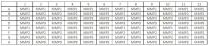
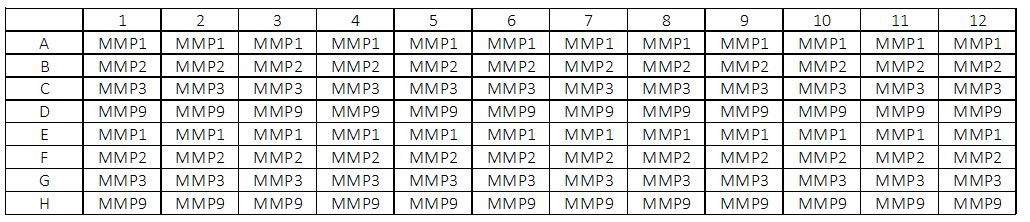
Antibodies Coating Pattern In Microtiter Plate of ARG83825 arigoPLEX® Human MMP Multiplex ELISA Kit
-
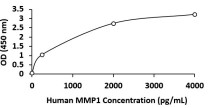
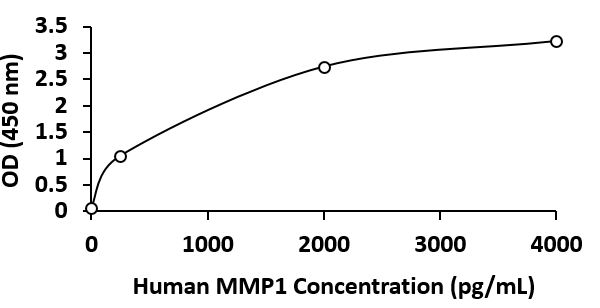
ARG83825 arigoPLEX® Human MMP Multiplex ELISA Kit standard curve image
ARG83825 arigoPLEX® Human MMP Multiplex ELISA Kit results of a typical standard for Human MMP1 run with optical density reading at 450 nm.
-
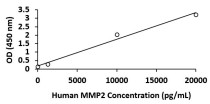
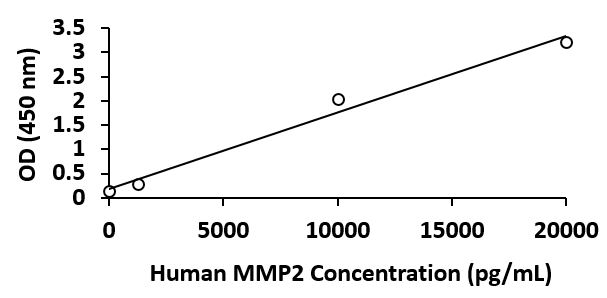
ARG83825 arigoPLEX® Human MMP Multiplex ELISA Kit standard curve image
ARG83825 arigoPLEX® Human MMP Multiplex ELISA Kit results of a typical standard for Human MMP2 run with optical density reading at 450 nm.
-
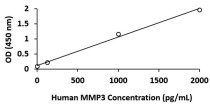
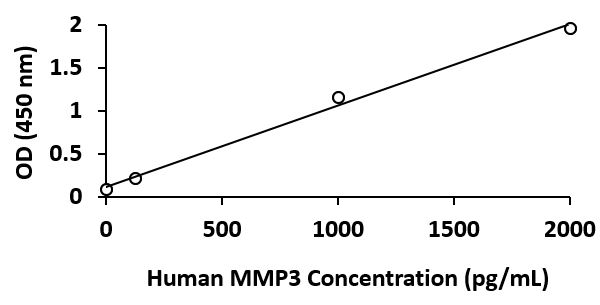
ARG83825 arigoPLEX® Human MMP Multiplex ELISA Kit standard curve image
ARG83825 arigoPLEX® Human MMP Multiplex ELISA Kit results of a typical standard for Human MMP3 run with optical density reading at 450 nm.
-
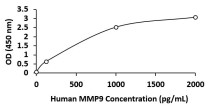
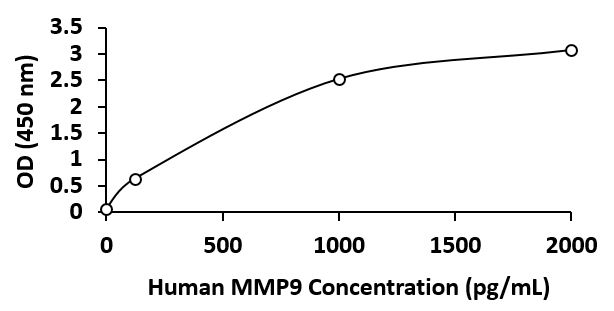
ARG83825 arigoPLEX® Human MMP Multiplex ELISA Kit standard curve image
ARG83825 arigoPLEX® Human MMP Multiplex ELISA Kit results of a typical standard for Human MMP9 run with optical density reading at 450 nm.
| Title | Download Link |
|---|---|
| ARG83825 arigoPLEX® Human MMP Multiplex ELISA Kit User manual |
 Download Download
|